
Two serpents from different eras stand as titans of the snake world. The king cobra rules modern Asia with lethal venom and lightning strikes, while Titanoboa dominated prehistoric South America through sheer crushing power and massive size.
This matchup pits speed and toxicity against raw strength and enormous bulk. Readers will learn how each snake’s unique weapons compare, what advantages each brings to battle, and which serpent would likely emerge victorious from this clash of nature’s most formidable constrictors and venomous predators.
Contender 1: King Cobra
The king cobra stretches up to 18 feet long, making it the longest venomous snake alive today. This serpent can weigh around 20 pounds despite its impressive length. Its slender build allows for quick movements and strikes that few prey animals can dodge.
The cobra’s fangs measure only half an inch, but size means nothing when venom does the work. Each bite delivers enough neurotoxin to kill an elephant or 20 humans. The venom attacks the nervous system, causing paralysis and respiratory failure within minutes.
Beyond its deadly bite, the king cobra can lift a third of its body off the ground. This raising ability lets it strike at eye level with large mammals. The famous hood spreads wide to make the snake appear larger and more threatening to potential enemies.
The scales provide decent protection against scratches and minor injuries. However, the real defense lies in the snake’s speed and awareness. King cobras can sense vibrations through the ground and track prey by scent using their forked tongues.
Fun fact: King cobras are the only snakes that build nests for their eggs, and mothers guard them fiercely for up to three months, refusing to eat during the entire period.
Contender 2: Titanoboa
Titanoboa cerrejonensis lived 60 million years ago in what is now Colombia. This prehistoric monster measured 42 feet long and weighed over 2,500 pounds. That makes it roughly three times longer than a king cobra and more than 100 times heavier.
The skull alone measured two feet long with jaws that could open wide enough to swallow crocodiles whole. Those massive jaws contained dozens of backward-curving teeth. Each tooth acted like a hook, preventing prey from escaping once caught.
Titanoboa was a constrictor, not a venomous snake. Its primary weapon was crushing force generated by thick bands of muscle. Scientists estimate it could exert pressure exceeding 400 pounds per square inch. This force could snap bones and stop hearts in seconds.
The snake’s thick scales formed armor plating across its entire body. Each scale overlapped like roof tiles, creating a flexible yet protective barrier. Sharp objects would struggle to penetrate this natural armor, especially given the layers of muscle beneath.
Speed was not Titanoboa’s strength on land, but in water it moved with surprising agility. The snake likely spent much time in rivers and swamps where its size became less of a burden. Ambush hunting from murky water gave it a tactical advantage over land-based prey.
Fun fact: Titanoboa could only exist because of the extreme heat of its era, as the warmer climate allowed cold-blooded reptiles to grow to massive sizes that would be impossible in today’s cooler temperatures.
Head-to-Head
| Feature | King Cobra | Titanoboa |
|---|---|---|
| Size | Up to 18 feet | 42 feet |
| Weight | 20 pounds | 2,500+ pounds |
| Speed | 12 mph | 3-5 mph on land |
| Bite Force | 200 PSI | 400+ PSI |
| Key Strength | Deadly neurotoxin venom | Crushing constriction power |
| Main Weakness | Fragile body, easily injured | Slow movement on land |
| Offense Tools | Venomous fangs, quick strikes | Massive jaws, constricting coils |
| Defense Tools | Speed, agility, hood display | Thick scales, enormous size |
| Combat Strategy | Strike and retreat | Grab and constrict |
King Cobra vs. Titanoboa: The Showdown
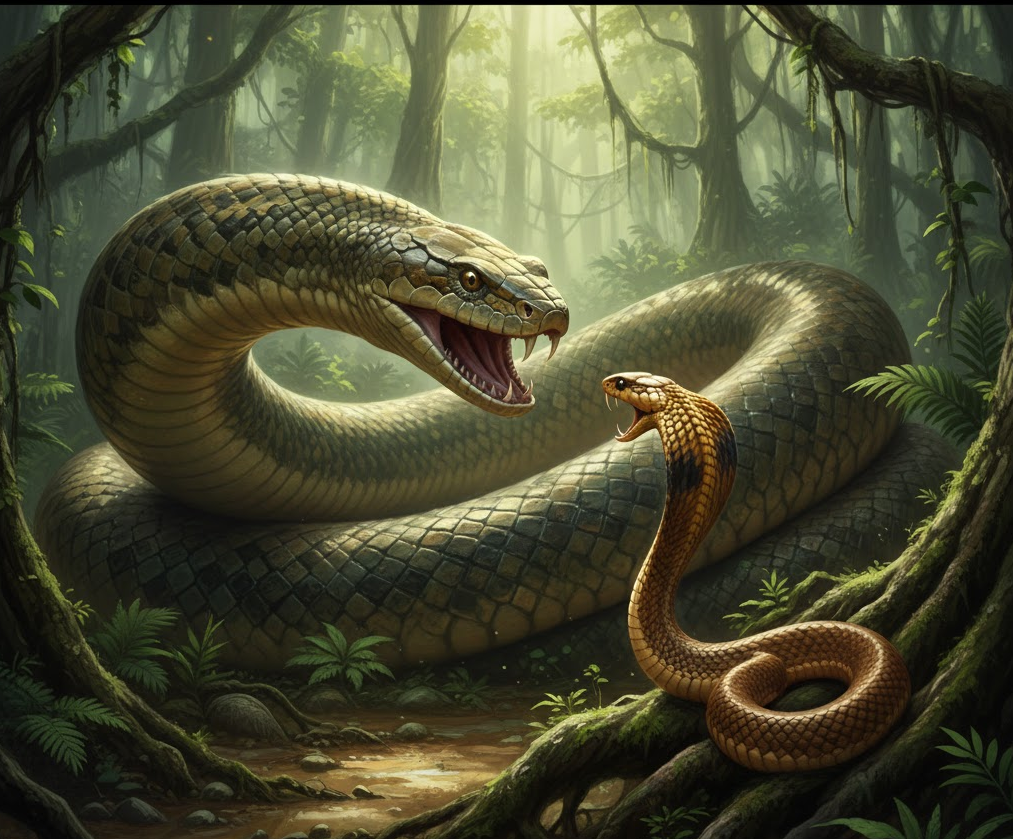
The king cobra detects vibrations through the forest floor. Something massive approaches. The snake rises three feet off the ground, hood flaring wide. Across the clearing, the Titanoboa emerges from the undergrowth, its body as thick as a tree trunk.
The cobra strikes first, launching forward with incredible speed. Its fangs sink into Titanoboa’s thick hide near the head. Venom pumps into the prehistoric giant. The cobra immediately recoils, putting distance between itself and the massive predator.
Titanoboa barely registers the bite. The thick scales and layers of fat cushion the fangs’ penetration. The venom enters the bloodstream, but the prehistoric snake’s enormous body dilutes it significantly. What would kill an elephant in minutes will take much longer to affect a creature 30 times heavier.
The Titanoboa lunges forward with surprising speed for its size. Its massive jaws snap shut, but the king cobra’s agility saves it. The smaller snake darts sideways, then strikes again at a different spot. Another dose of venom enters the giant.
But Titanoboa has closed the distance now. One massive coil whips around, catching the king cobra mid-retreat. The prehistoric snake’s body wraps around the cobra before it can escape. Another coil follows, then another.
The king cobra writhes and struggles, but it’s like fighting steel cables. The pressure builds rapidly. At 400 pounds per square inch, Titanoboa’s constriction exceeds what the cobra’s body can withstand. Ribs crack within seconds.
The cobra manages one more bite into the coil wrapped around it. More venom flows, but time has run out. The crushing force continues to build. Blood flow stops, organs rupture, and the king cobra’s struggles weaken rapidly.
Even as the Titanoboa maintains its death grip, the venom begins working. The prehistoric snake’s movements grow sluggish. However, the neurotoxin must travel through 2,500 pounds of muscle, fat, and tissue. This takes considerable time.
Minutes pass. The king cobra has stopped moving, its body crushed beyond survival. The Titanoboa slowly releases its grip and begins to feel the venom’s full effects. Muscle weakness spreads, but the giant snake has already won. It may suffer from the venom for hours or even die later, but its opponent lies dead.
Titanoboa wins this fight 8 out of 10 times. The size and strength advantage simply proves too much for the king cobra to overcome.
King Cobra vs. Titanoboa: Who Would Win?
Titanoboa would most likely win this battle through overwhelming physical superiority. While the king cobra’s venom is lethal, it cannot kill the prehistoric giant fast enough to prevent being caught and crushed.
Points to note:
- The king cobra’s venom would eventually kill Titanoboa if given enough time, possibly hours after the fight ends
- In water, Titanoboa’s advantage increases dramatically as the cobra loses its speed edge
- A king cobra might survive by avoiding engagement entirely, as its superior agility allows escape
- The size difference is so extreme that even multiple king cobra bites might not deliver enough venom quickly enough
- Temperature plays a role, as both snakes perform better in warm conditions but Titanoboa requires more heat
- If the king cobra struck the eyes or inside the mouth where scales are thinner, venom delivery would be more effective
- The fight assumes both snakes are healthy adults at peak condition
- Titanoboa’s extinction means this battle cannot occur naturally, as the two species are separated by 60 million years
- Younger or smaller Titanoboas would face greater risk from the venom’s effects
- The king cobra could win if it landed multiple perfect strikes before being caught, though this remains unlikely given the prehistoric snake’s durability