
The king cobra strikes fear into the hearts of many with its deadly venom and imposing hood. The crocodile, on the other hand, is an ancient predator with jaws that can crush bone. Both animals are apex predators in their respective domains, each equipped with fearsome weapons.
This matchup brings together two of nature’s most dangerous creatures. One relies on speed and neurotoxic venom. The other depends on brute strength and an armored body.
This article explores the physical abilities of both animals, compares their strengths and weaknesses, and analyzes what would happen if these two predators met in combat.
Contender 1: King Cobra
The king cobra stands as the longest venomous snake on Earth, reaching lengths of up to 18 feet. Adult males typically measure between 12 to 15 feet, while females are slightly smaller. This impressive size gives the cobra a significant reach advantage over most opponents.
The snake’s venom is its primary weapon. A single bite can deliver enough neurotoxin to kill an elephant or 20 humans. The venom attacks the nervous system, causing paralysis, respiratory failure, and death within hours if left untreated. King cobras possess large venom glands and can inject substantial amounts in a single strike.
Their fangs are relatively short compared to other venomous snakes, measuring about half an inch long. However, these fangs are fixed in place and highly efficient at delivering venom deep into tissue. The cobra can control its venom release, choosing to deliver a dry bite or a full envenomation depending on the threat level.
Speed is another critical asset. King cobras can strike at speeds of up to 12 feet per second, making their attacks nearly impossible to dodge at close range. They can also raise up to one-third of their body length off the ground, giving them an elevated striking position. This vertical reach can be 4 to 6 feet high.
The iconic hood serves both defensive and offensive purposes. When threatened, the cobra spreads its neck ribs to create this distinctive display, making itself appear larger and more intimidating. The hood also features false eye markings on the back in some regions, which can confuse predators. The snake’s scales provide minimal armor but offer flexibility for rapid movement.
Fun fact: King cobras are the only snakes that build nests for their eggs, and the mother guards them fiercely, refusing to eat for the entire incubation period of 60 to 80 days.
Contender 2: Crocodile
Crocodiles are living fossils that have remained largely unchanged for over 200 million years. Depending on the species, they range from 6 feet to over 20 feet in length. Saltwater crocodiles are the largest, with males reaching 17 to 23 feet and weighing up to 2,200 pounds. Nile crocodiles are similarly imposing, growing up to 16 to 20 feet long.
The crocodile’s bite force is legendary. Saltwater crocodiles possess the strongest bite force of any living animal, measured at 3,700 pounds per square inch. Even smaller species deliver crushing bites that can shatter bones instantly. Once those jaws clamp down, the prey has virtually no chance of escape.
Their teeth are designed for gripping rather than chewing. Crocodiles have between 60 to 110 teeth, all conical and razor-sharp. These teeth interlock when the jaw closes, creating a perfect trap. If a tooth breaks, a new one grows in its place. A crocodile can go through 3,000 teeth in a lifetime.
Armor plating covers the crocodile’s entire dorsal surface. These osteoderms are bony plates embedded in the skin, providing protection against bites, claws, and strikes. The scales on the belly are softer but still tough. This natural armor makes crocodiles nearly impervious to most attacks.
Crocodiles are surprisingly fast in short bursts. On land, they can reach speeds of 10 to 12 miles per hour when charging. In water, they can swim at 15 to 18 miles per hour using their powerful tails. The tail itself is a weapon, capable of delivering devastating blows that can break bones or knock prey off balance.
Their hunting strategy relies on patience and explosive power. Crocodiles can remain motionless for hours, then launch a lightning-fast ambush. The death roll is their signature killing technique. Once they grab prey, they spin rapidly to tear off chunks of flesh or drown the victim. This technique is brutally effective against animals of all sizes.
Fun fact: Crocodiles have a special valve at the back of their throat that allows them to open their mouths underwater without drowning, enabling them to catch and hold prey beneath the surface for extended periods.
Head-to-Head
| Category | King Cobra | Crocodile |
|---|---|---|
| Size | 12-18 feet long | 10-23 feet long (species dependent) |
| Weight | 12-20 pounds | 500-2,200 pounds |
| Speed | Strike speed: 12 ft/sec; Movement: 5 mph | Land: 10-12 mph; Water: 15-18 mph |
| Bite Force | 10-15 PSI | 2,500-3,700 PSI |
| Key Strength | Deadly neurotoxic venom | Crushing bite force and armored body |
| Main Weakness | Fragile body, vulnerable to crushing | Vulnerable underbelly, slow on land |
| Offense Tools | Venomous fangs, quick strikes, reach | Powerful jaws, teeth, tail, death roll |
| Defense Tools | Speed, agility, intimidation display | Thick armored scales, immense size |
| Combat Strategy | Strike vital areas, inject venom, retreat | Ambush, bite, hold, death roll, drown |
King Cobra vs. Crocodile: The Showdown
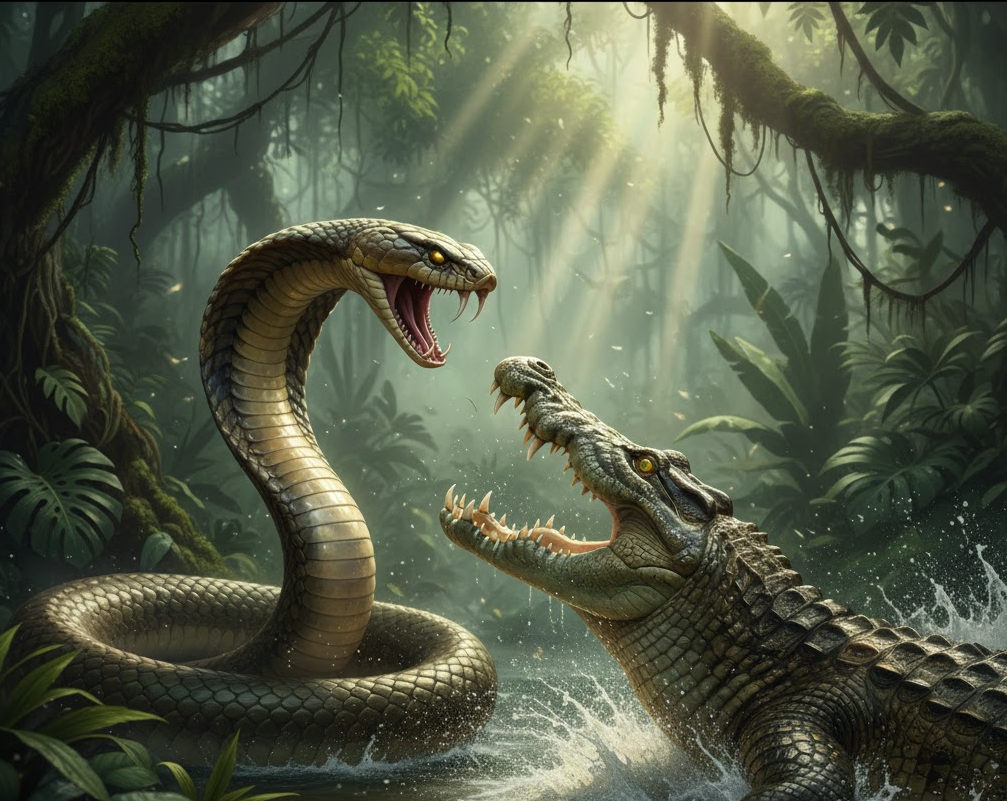
The encounter begins at the edge of a shallow river where the crocodile has been basking. The king cobra, searching for food, approaches the water’s edge unaware of the danger lurking nearby. The crocodile spots the movement and immediately locks onto the snake as potential prey.
The cobra senses vibrations through the ground and raises its head. It quickly assesses the massive reptile before it. The snake rears up, spreading its hood wide in a defensive display. Standing nearly five feet tall, the cobra tries to appear as threatening as possible. The crocodile remains motionless, calculating its approach.
The cobra makes the first move, striking at the crocodile’s head with lightning speed. Its fangs make contact but barely penetrate the thick scales covering the crocodile’s skull. The neurotoxic venom enters the crocodile’s system, but the massive reptile’s size works in its favor. The amount of venom needed to affect a 1,500-pound crocodile is far more than what the cobra delivered in a single strike.
Sensing the attack failed, the cobra strikes again. This time it aims for the crocodile’s eye, one of the few vulnerable spots on the armored predator. The crocodile snaps its head to the side, and those massive jaws clamp down on empty air. The cobra’s speed keeps it just out of reach.
The crocodile lunges forward with surprising speed. Its jaws open wide, revealing rows of interlocking teeth. The cobra tries to dodge, but the crocodile’s explosive power covers the distance too quickly. Those jaws slam shut on the cobra’s midsection with bone-crushing force.
The snake wraps its body around the crocodile’s snout in a desperate attempt to escape or constrict. But constrictors like pythons and anacondas specialize in squeezing, not king cobras. The cobra’s thin body lacks the muscular power needed to restrict the crocodile’s breathing or movement. The crocodile simply shakes its head violently.
Feeling the cobra still moving, the crocodile begins its signature death roll. The massive reptile spins rapidly in the shallow water, using its entire body weight and momentum. The cobra’s spine snaps almost immediately under the rotational force. Within seconds, the snake’s body goes limp.
The crocodile continues the death roll several more times to ensure its prey is dead. The cobra’s body tears in multiple places from the sheer force. The fight is over in less than a minute. The crocodile drags what remains of the snake into deeper water to consume later.
The king cobra never stood a real chance. Its venom requires time to work, but the crocodile’s physical attack was immediate and overwhelming. Even if the cobra had managed multiple bites on softer tissue, the crocodile’s massive body mass would delay the venom’s effects long enough for the reptile to kill the snake first. The size and strength difference proved insurmountable.
The crocodile wins this matchup with approximately 95% certainty. Only in rare circumstances where a cobra manages multiple bites to vulnerable areas like the throat or eyes, combined with the crocodile being young or sick, might the outcome differ.
King Cobra vs. Crocodile: Who Would Win?
The crocodile would win this fight decisively. The massive size difference, armored body, and crushing bite force give the crocodile overwhelming advantages that the cobra’s venom cannot overcome quickly enough.
Points to note:
- The cobra’s venom would eventually kill the crocodile if enough entered the bloodstream, but death would take hours while the crocodile can kill the snake in seconds
- Size matters significantly in this matchup; a small juvenile crocodile (under 6 feet) would be more vulnerable to cobra venom
- These animals rarely encounter each other in nature, as king cobras prefer forests and grasslands while most crocodiles inhabit water bodies
- The terrain heavily influences the outcome; in water, the crocodile has an even greater advantage
- A cobra might choose to flee rather than fight such a large, armored opponent
- Crocodile scales are difficult for cobra fangs to penetrate except in vulnerable areas like the throat, eyes, or belly
- The cobra’s speed advantage only helps if it can escape; in direct combat, speed cannot overcome the size and power differential
- Temperature affects both animals’ performance, with colder conditions slowing both reptiles but impacting the snake more severely