
Two of nature’s fiercest tusked warriors face off in a battle that could shake the ground beneath them. The warthog, Africa’s armored speedster, meets the wild boar, Europe’s relentless forest fighter.
This matchup brings together two pig species that have evolved to dominate their territories through pure aggression and formidable weaponry. Both animals carry razor-sharp tusks and possess the attitude to use them without hesitation.
This article examines their physical attributes, fighting capabilities, and tactical advantages to determine which tusked beast would emerge victorious in a head-to-head clash.
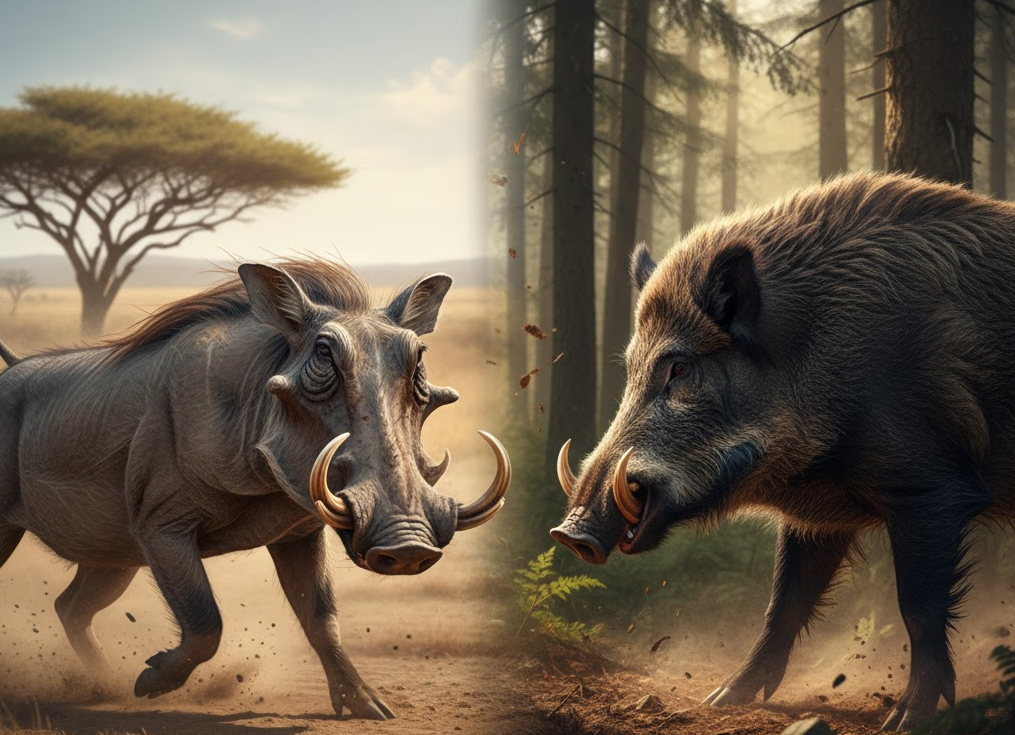
Contender 1: Warthog
The warthog stands as one of Africa’s most distinctive wild pigs, sporting a broad head adorned with prominent facial warts that give this animal its name. Males typically weigh between 110 to 330 pounds, with females running slightly smaller at 100 to 165 pounds. Their body length stretches from 3 to 5 feet, and they stand about 25 to 33 inches tall at the shoulder.
The warthog’s primary weapons are its impressive tusks, which grow continuously throughout its life. The upper tusks can reach lengths of 10 to 25 inches and curve upward in a menacing arc. Lower tusks, though shorter at 6 inches, stay sharper because the animal grinds them against the upper tusks, creating blade-like edges capable of inflicting devastating wounds.
Their thick, tough skin provides excellent protection against attacks, particularly around the head and shoulders where combat damage typically occurs. This natural armor proves especially valuable during territorial disputes with other males. The skin can be up to an inch thick in certain areas, acting like built-in body armor that deflects bites and slashing attacks.
Speed serves as another crucial asset in the warthog’s arsenal. These animals can sprint at speeds reaching 30 miles per hour when threatened or charging an opponent. Their ability to make quick directional changes while running makes them difficult targets to pin down. Despite their stocky build, warthogs display surprising agility when fighting or fleeing.
Fun fact: Warthogs often kneel on their front legs while feeding, developing thick calluses on their wrists that allow them to comfortably forage in this unusual position for hours each day.
Contender 2: Wild Boar
The wild boar represents one of the most widespread and adaptable large mammals on Earth, with populations spanning Europe, Asia, and introduced territories across multiple continents. Adult males commonly weigh between 165 to 220 pounds, though exceptional specimens can exceed 300 pounds. These powerfully built animals measure 3 to 6 feet in length and stand 22 to 39 inches tall at the shoulder.
Wild boars possess formidable tusks that grow from their lower jaw, with the upper and lower teeth grinding against each other to maintain deadly sharp points. Male tusks can reach lengths of 3 to 5 inches, though some individuals grow them significantly longer. These curved weapons can slice through flesh and muscle with minimal effort, and boars know exactly how to use them for maximum damage.
Their body composition favors combat effectiveness. A thick layer of subcutaneous fat combined with dense muscle mass creates a protective shield around vital organs. Male boars develop an especially tough shoulder shield, a hardened area of skin and tissue that can be several inches thick. This shield forms specifically to protect against the tusks of rival males during fights.
The wild boar’s skull structure provides additional defensive capabilities. Their elongated snout houses powerful jaw muscles capable of delivering bone-crushing bites. The skull itself features thick bone that can withstand significant impact, allowing boars to engage in head-to-head shoving matches without sustaining serious injury.
Aggression levels in wild boars exceed those of most other animals their size. These creatures attack with little provocation when they feel threatened or challenged. Their fearless nature, combined with their physical tools, makes them dangerous opponents for predators many times their size. Even bears and big cats approach wild boars with caution.
Wild boars demonstrate remarkable endurance during confrontations. They can maintain aggressive behavior for extended periods, refusing to back down even when injured. This stamina, paired with their pain tolerance, means they continue fighting long after other animals would retreat. Their muscular build supports sustained physical exertion during prolonged battles.
Fun fact: Wild boars can detect food sources buried up to three feet underground using their sensitive snouts, and their rooting behavior completely transforms landscapes by turning over hundreds of pounds of soil daily.
Head-to-Head
| Category | Warthog | Wild Boar |
|---|---|---|
| Size | 3-5 feet long, 25-33 inches tall | 3-6 feet long, 22-39 inches tall |
| Weight | 110-330 pounds | 165-220 pounds (up to 300+) |
| Speed | 30 mph | 25 mph |
| Bite Force | Moderate, ~450 PSI | Strong, ~500 PSI |
| Key Strength | Superior speed and agility | Shoulder shield and endurance |
| Main Weakness | Less body armor overall | Slightly slower movement |
| Offense Tools | Long curved tusks (10-25 inches upper, 6 inches lower) | Sharp tusks (3-5 inches), powerful bite |
| Defense Tools | Thick head/shoulder skin, speed | Dense shoulder shield, thick fat layer, tough skull |
| Combat Strategy | Swift charges, slashing attacks, tactical retreats | Relentless pressure, head-on assaults, sustained aggression |
Warthog vs. Wild Boar: The Showdown
The confrontation begins when a male warthog accidentally crosses into territory where a large wild boar has been foraging. Both animals immediately recognize each other as threats. The boar releases a low grunt and turns to face the intruder. The warthog raises its tail straight up, a clear signal it has no intention of backing down.
The wild boar makes the first move, charging forward with its head lowered and tusks ready. The warthog responds with surprising quickness, darting to the side and avoiding the initial rush. As the boar passes, the warthog pivots and slashes with its curved upper tusks, catching the boar’s flank. The blow leaves a shallow cut but fails to penetrate the thick fat layer protecting the boar’s side.
The boar wheels around faster than expected for an animal its size. Both combatants circle each other, looking for openings. The warthog feints left, then dashes right, attempting to use its speed advantage. The boar anticipates the move and meets the warthog head-on, their skulls crashing together with a sound like splitting wood.
Both animals stagger from the impact. The warthog recovers first, taking advantage of the moment to drive forward with its tusks aimed at the boar’s neck. The boar’s shoulder shield takes most of the strike, the hardened tissue absorbing what could have been a fatal blow. The boar retaliates instantly, swinging its head upward and catching the warthog under the jaw with its lower tusks.
Blood flows from the warthog’s wound. The African pig backs away several steps, reassessing its opponent. The boar presses the advantage, refusing to give ground. It charges again, and this time the warthog cannot evade quickly enough. The two animals lock together, pushing and slashing in a brutal test of strength.
The warthog’s longer tusks find their mark multiple times, opening cuts across the boar’s head and shoulders. Each wound, however, seems to fuel the boar’s aggression rather than slow it down. The boar’s shorter but equally sharp tusks work like daggers at close range, puncturing the warthog’s hide in several places. The warthog’s armor, while thick around the head, proves less protective along its sides and legs.
Realizing the close-quarters battle favors its stockier opponent, the warthog attempts to break away. It manages to create some distance and circles around for another charge. The warthog builds up speed and aims for the boar’s vulnerable rear quarter. The boar, displaying the agility that makes its species so dangerous, spins to meet the charge.
The impact sends both animals stumbling. The warthog’s tusks score another hit, this time deeper, but the boar’s endurance keeps it in the fight. The boar counters with a vicious upward thrust that catches the warthog across the shoulder, leaving a serious gash. Both combatants now carry multiple injuries, but the boar shows less concern about its wounds.
The fight continues for several more brutal exchanges. The warthog tries using hit-and-run tactics, leveraging its speed to strike and retreat. These tactics work to some degree, allowing the warthog to land numerous blows. Each successful strike, however, requires significant energy, and the warthog begins to tire. The boar maintains its relentless pressure, never giving its opponent time to fully recover between attacks.
A critical moment arrives when the warthog attempts another charging slash. The boar, having learned the warthog’s patterns, times its counter perfectly. As the warthog commits to the attack, the boar drops its head and drives forward with all its mass. The collision catches the warthog off-balance, and the boar’s tusks find the softer tissue of the warthog’s throat area.
The wound proves serious. The warthog stumbles backward, blood flowing freely. The boar does not relent. It presses forward with mechanical persistence, landing several more solid hits while the warthog’s movements become increasingly labored. The African pig attempts one last desperate charge, but its strength has faded too much to make the attack effective.
The boar sidesteps and delivers a final blow to the warthog’s side. The warthog, recognizing it cannot continue, turns and flees at whatever speed its injuries allow. The boar chases for a short distance before stopping, satisfied that the threat has been eliminated from its territory.
The wild boar emerges victorious roughly 65 to 70 percent of the time in this matchup. Its combination of dense protective armor, superior endurance, and unwavering aggression proves decisive against the warthog’s speed and longer tusks.
Warthog vs. Wild Boar: Who Would Win?
The wild boar would most likely win this fight due to its superior body armor, exceptional endurance, and relentless fighting style that neutralizes the warthog’s speed advantage. While the warthog possesses longer tusks and greater agility, these advantages cannot overcome the boar’s ability to absorb punishment and maintain sustained aggression throughout an extended battle.
Points to note:
• The warthog’s best chance of victory comes from landing a perfect strike early in the fight, using its longer tusks to inflict a critical wound before the boar can close the distance
• Environmental factors could swing the outcome significantly, with open terrain favoring the warthog’s speed-based tactics while dense vegetation would limit mobility and favor the boar
• Individual variation matters tremendously in this matchup, as an exceptionally large warthog facing an average-sized boar could reverse the typical outcome
• Both animals would likely avoid this confrontation in nature since their ranges rarely overlap, with warthogs inhabiting African savannas and wild boars preferring European and Asian forests
• The warthog’s tendency to flee into burrows when seriously threatened means most real encounters would end with escape rather than a fight to the finish
• Climate and season could affect performance, as warthogs handle heat better while boars possess greater cold tolerance and might fight more effectively in cooler conditions
• Prior fighting experience would influence the result, with battle-hardened individuals of either species gaining substantial advantages over less experienced opponents