
Few matchups in the African savanna pit brute strength against raw survival instinct quite like a warthog facing down a lion. These encounters happen more often than you might think, with predator and prey locked in a deadly test of power, speed, and cunning.
What happens when a lion’s hunting prowess meets a warthog’s fierce defensive arsenal? This article breaks down each animal’s physical capabilities, combat tools, and fighting strategies to determine who walks away from this brutal confrontation.
Contender 1: Warthog
The warthog stands as one of Africa’s most underestimated fighters, built like a compact tank with weapons that can gore even the largest predators. Adult males reach lengths of 150 cm and stand about 85 cm tall at the shoulder. Their bodies are covered in sparse, bristly hair that offers minimal protection but their thick skin provides a natural armor against slashing attacks.
The warthog’s most dangerous weapons are its four sharp tusks that curve upward from both jaws. The upper tusks can grow up to 60 cm long in males, creating scythe-like blades capable of slicing through flesh and breaking bones. These tusks are constantly sharpened as the upper and lower pairs grind against each other during feeding and threat displays.
Speed becomes the warthog’s secret advantage when retreat seems like the better option. Despite their stocky build and short legs, warthogs can sprint at speeds reaching 48 km per hour. This explosive acceleration helps them reach the safety of their burrows, which they enter backwards to keep their tusks facing any pursuing threat.
Their defense strategy centers on the burrow system they either dig themselves or commandeer from other animals like aardvarks. When cornered outside a burrow, warthogs don’t flee blindly. They turn to face their attacker, lowering their heads to bring those deadly tusks to bear, ready to charge and slash upward at vulnerable underbellies.
Fun fact: Warthogs are one of the few animals that kneel on their front legs while eating, using special calluses on their wrists to protect their knees. This unusual feeding position allows them to graze low grasses while keeping their heads up to watch for predators, giving them precious seconds of warning before an attack.
Contender 2: Lion
Lions reign as Africa’s apex predators, with males weighing between 180 to 250 kg of pure muscle and deadly hunting machinery. Their bodies stretch up to 3 meters long including the tail, and they stand 1.2 meters tall at the shoulder. Male lions carry the added advantage of a thick mane that protects their neck and throat from bites and claw strikes during fights.
The lion’s bite delivers crushing force measured at 650 PSI, strong enough to crack bones and sever spinal cords with surgical precision. Their jaws contain 30 teeth, including four canines that reach 8 cm in length. These fangs pierce deep into prey, finding vital arteries and airways with practiced efficiency.
Each massive paw conceals five retractable claws on the front feet and four on the back, razor-sharp and curved like meat hooks. Lions use these claws to grip and hold prey, raking through hide and muscle to inflict devastating wounds. A single swipe from a lion’s paw can break a zebra’s back or crush a skull.
Hunting tactics separate lions from other big cats through their combination of stealth, patience, and explosive power. They stalk to within 30 meters of their target before launching an attack that reaches speeds of 80 km per hour in short bursts. This speed advantage lets them close the distance before most prey can react.
Lions possess incredible stamina during close combat, capable of wrestling and subduing animals much larger than themselves. Their muscular shoulders and forelimbs provide the strength to pull down buffalo and even young elephants. This raw power combines with strategic intelligence, as lions learn to target specific weaknesses in different prey species.
Fun fact: A lion’s tongue is covered in tiny, backward-facing spines called papillae that are so rough they can lick the meat off bones and even remove paint from walls. These spines help lions groom their fur and clean every scrap of meat from their kills, but they also make a lion’s lick feel like sandpaper against skin.
Head-to-Head
| Attribute | Warthog | Lion |
|---|---|---|
| Size | 150 cm long, 85 cm tall | 300 cm long, 120 cm tall |
| Weight | 60-150 kg | 180-250 kg |
| Speed | 48 km/h | 80 km/h |
| Bite Force | 450 PSI | 650 PSI |
| Key Strength | Tusks and aggressive defense | Power, speed, and hunting experience |
| Main Weakness | Smaller size and weight | Energy depletes quickly in extended fights |
| Offense Tools | Four sharp tusks, charging attacks | Claws, powerful bite, crushing weight |
| Defense Tools | Thick skin, backwards burrow retreat, frontal defense stance | Thick mane (males), agility, superior reflexes |
| Combat Strategy | Face attacker with tusks forward, charge at vulnerable areas | Stalk and ambush, overwhelm with speed and power |
Warthog vs. Lion: The Showdown
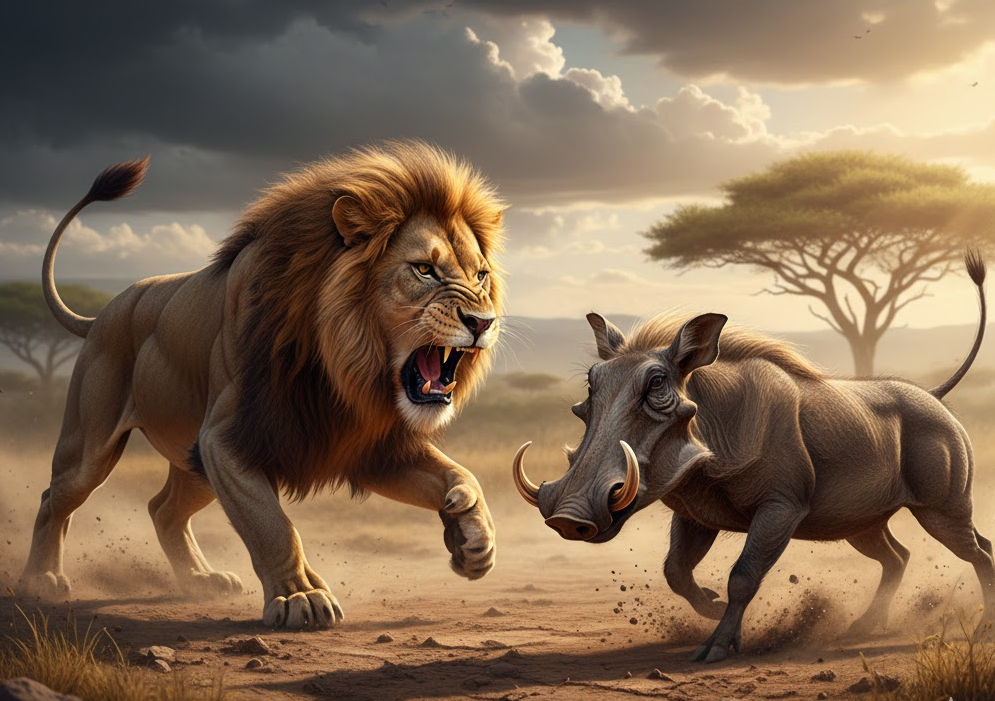
The warthog roots through dry grass 50 meters from its burrow when it catches the scent of danger on the afternoon breeze. A male lion crouches in the tall grass, muscles coiled like springs, eyes locked on his target. The distance between them shrinks as the lion creeps forward, but warthogs survive by staying alert.
The warthog’s head snaps up. It spots the lion immediately and breaks into a full sprint toward its burrow. The lion explodes from cover, his powerful legs eating up ground at speeds the warthog cannot match. Dust flies as both animals race across the open savanna, but the lion closes the gap with terrifying speed.
Twenty meters from safety, the warthog knows it won’t make the burrow in time. It slams to a halt and spins to face the charging predator, lowering its head to present its tusks. The lion pulls up short, circling warily, looking for an opening as the warthog pivots to keep those deadly weapons pointed at him.
The lion feints left, testing the warthog’s reactions. The smaller animal charges forward with surprising aggression, slashing upward with its tusks. The lion leaps back, barely avoiding the razor-sharp ivory that could have opened his belly. This warthog won’t go down easily, and the lion reassesses his strategy.
Patience becomes the lion’s new weapon as he circles slowly, forcing the warthog to keep turning. Each rotation drains energy and creates momentary gaps in defense. The lion waits for fatigue to set in, watching for that split-second when the warthog’s guard drops.
The opening comes when the warthog steps on uneven ground and stumbles slightly. The lion springs forward in a blur of tawny muscle, using his superior weight and reach. His massive paw crashes into the warthog’s shoulder, spinning the smaller animal sideways. Before the warthog can recover its defensive stance, the lion’s jaws clamp onto its neck.
The bite doesn’t kill instantly. The warthog thrashes violently, its tusks still dangerous even in this desperate moment. One tusk catches the lion’s foreleg, tearing a gash through muscle. The lion roars in pain but doesn’t release his grip, instead biting down harder and using his weight to force the warthog to the ground.
The struggle lasts another minute as the warthog’s movements grow weaker. The lion’s suffocating bite and crushing weight prove too much to overcome. The warthog’s resistance fades, and the lion emerges victorious, though bleeding from the tusk wound that will remind him this meal came at a cost.
The lion wins this fight roughly 80% of the time through superior size, speed, and killing experience that warthogs simply cannot match.
Warthog vs. Lion: Who Would Win?
The lion takes this fight in most scenarios because its combination of size, speed, and predatory expertise overwhelms the warthog’s defensive capabilities. While warthog tusks pose a real threat that can injure or even kill a lion, the big cat’s hunting skills and physical advantages tip the scales decisively in its favor.
Points to note:
• Adult warthogs successfully escape lions more often than they fight them, especially when they reach their burrows before contact occurs
• Warthogs have killed lions with lucky tusk strikes to the throat, belly, or femoral artery, proving they’re not helpless prey
• Male lions with thick manes survive warthog encounters more safely than females, who lack this protective neck armor
• Lions typically target young, old, or sick warthogs rather than healthy adults because the risk of injury makes prime warthogs less appealing prey
• A warthog cornered in its burrow becomes nearly impossible to kill, as the narrow entrance forces any attacker to face those tusks head-on
• Lions hunting in groups (prides) have success rates near 95% against warthogs, as multiple attackers eliminate the defensive advantage
• Injured or inexperienced young lions might lose to a determined adult warthog that lands a clean strike with its tusks
• Environmental factors like mud, which slows the lion but barely affects the lighter warthog, can shift the odds significantly
• Female warthogs defending piglets fight with even more ferocity than males, sometimes driving off lone lionesses through sheer aggression