
The African savanna sets the stage for countless animal encounters, but few matchups seem as mismatched as a warthog facing off against a cheetah. These two creatures occupy vastly different niches in the food chain, yet circumstances could bring them into direct conflict.
Understanding how each animal fights reveals surprising truths about survival in the wild. This article examines the weapons, defenses, and fighting styles of both the warthog and the cheetah to determine which would emerge victorious in a direct confrontation.
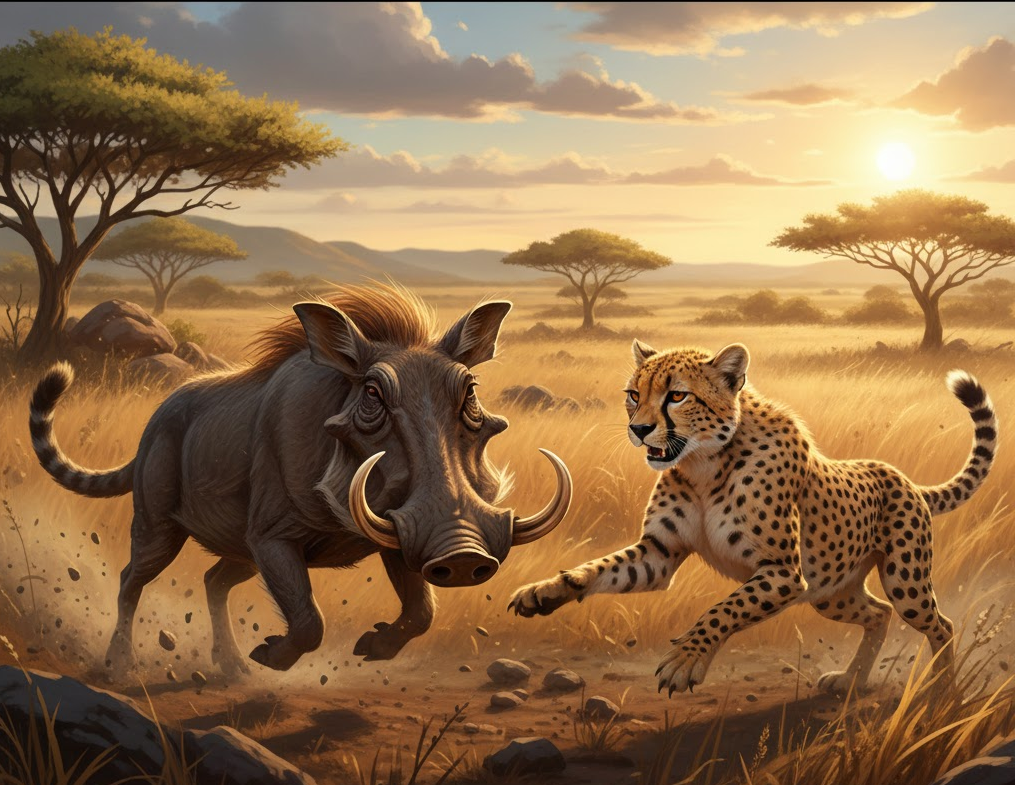
Contender 1: Warthog
The warthog stands as one of Africa’s most distinctive wild pigs, equipped with formidable natural weapons that make it a dangerous opponent. Adult male warthogs weigh between 110 and 330 pounds, with powerful, compact bodies built low to the ground. Their most striking features are the curved tusks protruding from their mouths, which can grow up to 25 inches long in males.
These tusks serve as the warthog’s primary offensive weapons. The lower tusks sharpen themselves against the upper ones, creating razor-sharp edges capable of inflicting devastating wounds. A charging warthog can slash upward with its tusks, targeting the soft underbelly of predators with deadly precision.
The warthog’s skull features thick bone and protective facial warts that give the species its name. These warts act as natural armor during fights with other warthogs and provide some protection against predator attacks. The animal’s hide, though not particularly thick, covers dense muscle that adds resilience.
Despite their stubby legs, warthogs can sprint at speeds up to 30 miles per hour when threatened. This surprising burst of speed often catches predators off guard. Their preferred defense strategy involves retreating into burrows backwards, keeping their dangerous tusks facing any pursuer.
Fun fact: Warthogs kneel on their front legs while feeding because their necks are too short to reach the ground comfortably while standing. This unusual posture makes them vulnerable to ambush attacks from predators.
Contender 2: Cheetah
The cheetah holds the title of fastest land animal on Earth, capable of reaching speeds up to 70 miles per hour in short bursts. This sleek predator weighs between 75 and 140 pounds, with males typically larger than females. Its body represents the ultimate evolution for speed, featuring a lightweight frame, long legs, and a flexible spine that acts like a spring during runs.
Unlike other big cats, cheetahs possess relatively weak bite force for their size. Their jaws and teeth are smaller than those of leopards or lions, trading crushing power for a lighter skull that enhances speed. The bite force measures only around 400 to 500 PSI, compared to a leopard’s 1,000 PSI.
The cheetah’s claws remain semi-retractable, providing traction during high-speed chases like running spikes. These claws lack the sharpness and curved design of other cats’ claws, making them less effective as weapons. The cheetah relies primarily on speed to catch prey, then uses a specialized bite to the throat that suffocates victims.
This cat’s build sacrifices power for velocity. The chest cavity houses an enlarged heart and lungs, while muscles are designed for explosive acceleration rather than sustained strength. A cheetah can accelerate from 0 to 60 miles per hour in just three seconds, faster than most sports cars.
The animal’s hunting strategy focuses on medium-sized prey like gazelles and impalas, typically weighing less than 90 pounds. Cheetahs avoid confrontation with larger animals and will abandon kills rather than risk injury. Their fragile bone structure makes them vulnerable to broken legs and ribs during physical combat.
After a high-speed chase, cheetahs require 20 to 30 minutes of recovery time before they can eat. This exhaustion period leaves them vulnerable to having their kills stolen by stronger predators. The species has evolved as a specialist hunter rather than a fighter, lacking the physical tools for prolonged battles.
Fun fact: Cheetahs cannot roar like other big cats. Instead, they chirp, purr, and make bird-like sounds to communicate. Mother cheetahs use a distinctive chirping call that sounds remarkably similar to a bird’s call to locate their cubs.
Head-to-Head
| Category | Warthog | Cheetah |
|---|---|---|
| Size | 30 inches tall at shoulder | 28-32 inches tall at shoulder |
| Weight | 110-330 pounds | 75-140 pounds |
| Speed | 30 mph | 70 mph |
| Bite Force | 450-500 PSI | 400-500 PSI |
| Key Strength | Razor-sharp tusks up to 25 inches long | Exceptional speed and agility |
| Main Weakness | Limited endurance in prolonged chases | Fragile build and weak bite |
| Offense Tools | Slashing tusks, ramming charge | Suffocating throat bite, paw swipes |
| Defense Tools | Thick skull, backward retreat to burrows, aggressive counterattacks | Speed and evasion |
| Combat Strategy | Aggressive frontal assault with upward tusk slashes | Quick ambush followed by throat bite |
Warthog vs. Cheetah: The Showdown
The confrontation begins near a watering hole where a male warthog drinks during the early morning hours. A female cheetah, desperate after three failed hunts, spots the pig and considers an attack. Hunger overrides her usual caution about targeting dangerous prey.
The cheetah crouches low in the tall grass, calculating her approach. She launches forward at full speed, covering the 50-yard distance in mere seconds. The warthog’s keen senses detect movement at the last moment, and he spins to face the threat rather than fleeing.
This split-second decision changes everything. The cheetah expected a fleeing target, not a 250-pound boar turning to fight. She attempts to adjust her trajectory, but momentum carries her forward. Her claws rake across the warthog’s shoulders as she tries to grip him, but his coarse hair and thick skin prevent a solid hold.
The warthog responds with explosive aggression. He drives upward with his tusks, the sharp points slicing through the cheetah’s exposed chest and foreleg as she passes over him. Blood flows from two deep gashes. The cheetah rolls away, her lightweight frame absorbing a hard impact with the ground.
Pain and instinct tell the cheetah this fight was a mistake. She attempts to create distance, but the injury to her foreleg slows her movements. The warthog charges, his tusks lowered like lances. The pig may lack the cheetah’s speed, but over short distances, his acceleration proves formidable.
The cheetah dodges the first charge, her agility still superior despite the wound. She circles, looking for an opening to deliver her signature throat bite. However, the warthog keeps his head low and tusks forward, eliminating safe angles of attack. Each time she attempts to close in, he whips his head sideways, forcing her to retreat.
Exhaustion begins affecting the cheetah after 90 seconds of intense activity. Her breathing becomes labored, and the leg wound continues bleeding. The warthog, though also breathing hard, shows no signs of backing down. His aggressive nature and territorial instincts keep him pressing the attack.
The cheetah makes one final attempt to end the fight. She feints left, then lunges for the warthog’s neck from the right side. The warthog anticipates the move and jerks his head upward violently. His tusk catches the cheetah’s shoulder, tearing through muscle and ligaments. The force of the blow knocks her off balance.
This injury proves catastrophic. The cheetah’s specialized body cannot withstand such trauma. She limps away from the engagement, blood matting her golden fur. The warthog pursues for several yards, ensuring the threat truly retreats, then returns to the water hole. He bears only superficial scratches from the cheetah’s claws.
The cheetah collapses 200 yards away, her damaged shoulder and foreleg making hunting impossible. Without the ability to run at full speed, she cannot catch prey. The wounds will likely become infected without treatment. Her specialized lifestyle leaves no room for such injuries.
The warthog wins this confrontation with approximately 85-90% certainty. His natural weapons and willingness to fight overcome the cheetah’s speed advantage in close quarters combat.
Warthog vs. Cheetah: Who Would Win?
The warthog emerges victorious in nearly all scenarios where these animals engage in direct combat. Its combination of dangerous tusks, aggressive fighting spirit, and sturdy build prove too much for the cheetah’s fragile, speed-optimized body to overcome.
Points to note:
- Cheetahs rarely hunt warthogs in nature because adult warthogs are too dangerous and heavy for them to safely kill. Cheetahs prefer prey they can quickly subdue without risk of injury.
- A surprise attack might give the cheetah an advantage if she could land a perfect throat bite before the warthog reacts, but warthogs have thick necks that make this difficult.
- The fight’s location matters significantly. Near burrows, the warthog can retreat to safety if needed. In open terrain, the cheetah has more room to use her speed advantage.
- Size disparity plays a crucial role. Male warthogs can weigh more than twice what a cheetah weighs, providing a massive advantage in any physical struggle.
- Cheetahs evolved to avoid confrontation with dangerous animals. Their survival strategy depends on staying injury-free, so they abandon risky situations quickly.
- A pack of cheetahs would change the outcome, though cheetahs typically hunt alone. Multiple attackers could overwhelm even an aggressive warthog.
- Juvenile warthogs make more realistic targets for cheetahs. Young pigs lack the size and weaponry to defend themselves effectively against a determined predator.
- The warthog’s backward retreat strategy proves highly effective. Predators face a difficult choice between abandoning the hunt or following dangerous tusks into a confined burrow.