
Speed defines both of these remarkable predators. The peregrine falcon rules the sky with breathtaking diving speeds, while the cheetah dominates the land with explosive sprints.
When these two champions of velocity face off, the outcome depends on far more than raw speed. This article breaks down their weapons, defenses, and tactics to determine which animal would emerge victorious in this ultimate clash.
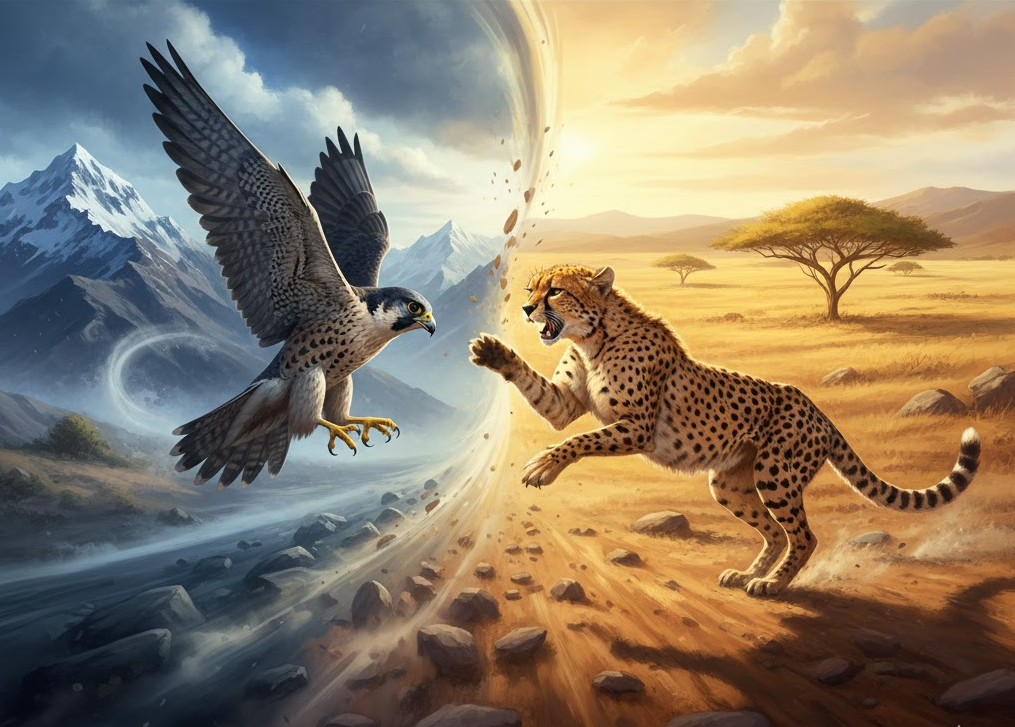
Contender 1: Peregrine Falcon
The peregrine falcon stands as the fastest animal on Earth, reaching speeds over 240 miles per hour during hunting dives called stoops. This medium-sized raptor weighs between 1.5 to 3.5 pounds and measures 14 to 19 inches long. Despite its modest size, this bird packs serious offensive power.
Sharp, curved talons serve as the falcon’s primary weapons. Each foot carries four razor-sharp claws designed to grip and pierce prey instantly. The falcon strikes with such force that the impact alone can kill prey mid-flight.
The hooked beak adds another lethal tool to the arsenal. Peregrines use a specialized tooth on their beak called a tomial tooth to sever the spinal cords of their victims. This quick kill method ensures prey dies almost instantly.
Exceptional eyesight gives the peregrine a major tactical advantage. These birds can spot prey from over two miles away and track fast-moving targets with precision. Their eyes process visual information faster than any mammal, allowing split-second adjustments during high-speed pursuits.
Fun fact: Peregrine falcons can see ultraviolet light, which helps them track urine trails left by small mammals on the ground, essentially giving them a heat-signature vision that reveals prey hiding spots from hundreds of feet in the air.
Contender 2: Cheetah
The cheetah holds the title of fastest land animal, capable of reaching 70 miles per hour in just three seconds. This big cat weighs between 75 to 140 pounds and stretches 3.5 to 4.5 feet long, with an additional tail measuring 25 to 31 inches. Built like a racing machine, every aspect of the cheetah’s body maximizes speed.
Long, powerful legs provide incredible acceleration and stride length. The cheetah’s flexible spine acts like a spring, extending and compressing with each bound to cover up to 25 feet in a single stride. Large nasal passages allow maximum oxygen intake during intense chases.
Semi-retractable claws offer exceptional traction during high-speed turns and sudden stops. Unlike other big cats, cheetahs cannot fully retract their claws, which function more like running spikes. This adaptation sacrifices climbing ability for superior ground grip.
Sharp teeth and strong jaws deliver the killing bite once prey is caught. Cheetahs have 30 teeth including four large canine teeth measuring about 1.5 inches long. However, their bite force measures only about 400 to 500 PSI, relatively weak compared to other big cats.
The lightweight skull and slender build create a significant vulnerability. Cheetahs sacrifice bone density and muscle mass for speed, making them fragile compared to other predators. Broken bones and injuries from fights can prove fatal since they cannot hunt while injured.
Fun fact: Cheetahs cannot roar like other big cats because they lack the specialized vocal cords, but they can purr continuously while breathing in and out, chirp like birds to communicate with their cubs, and make a distinctive stuttering sound called a “chirrup” when excited or greeting each other.
Head-to-Head
| Feature | Peregrine Falcon | Cheetah |
|---|---|---|
| Size | 14-19 inches long | 3.5-4.5 feet long |
| Weight | 1.5-3.5 pounds | 75-140 pounds |
| Speed | 240+ mph (diving) | 70 mph (running) |
| Bite Force | 30-40 PSI | 400-500 PSI |
| Key Strength | Aerial agility and diving speed | Land speed and endurance |
| Main Weakness | Vulnerable on ground | Fragile build, weak bite |
| Offense Tools | Talons, tomial tooth, impact strikes | Claws, teeth, paw swipes |
| Defense Tools | Flight, speed, maneuverability | Speed, agility, awareness |
| Combat Strategy | Hit-and-run aerial attacks | Chase down and overwhelm |
Peregrine Falcon vs. Cheetah: The Showdown
The encounter begins on an open savanna at dawn. The cheetah spots movement in the grass and crouches low, unaware that a peregrine falcon circles 500 feet overhead. The bird has already locked onto the cat as a potential threat near its nesting territory.
The falcon begins its assault without warning. Folding its wings tight against its body, it drops into a near-vertical stoop. The wind screams past as the bird accelerates past 200 miles per hour.
The cheetah’s acute hearing picks up the rush of air. It looks up just as the falcon closes the final 50 feet. The bird extends its talons forward, aiming for the cheetah’s head and neck.
Contact happens in a blur. The falcon’s talons rake across the cheetah’s face and skull, drawing blood. The impact staggers the cat, and the falcon immediately pulls up, climbing back into the sky. The cheetah shakes its head, disoriented by the sudden strike.
Blood trickles from gashes above the cheetah’s eye. The falcon circles again, preparing another dive. This time the cheetah watches the sky, muscles tensed and ready.
The second attack comes from a different angle. The falcon commits to another high-speed dive, but the cheetah times its movement perfectly. As the bird swoops down, the cat leaps sideways with explosive speed. The falcon misses its target by inches.
Now the dynamic shifts. The falcon must pull up sharply to avoid hitting the ground. During this vulnerable moment, the cheetah lunges upward. One massive paw swipes through the air, catching the falcon’s tail feathers.
The bird tumbles through the air but recovers quickly. Several feathers float to the ground. The falcon gains altitude again, but the cheetah has learned its pattern. Each subsequent dive becomes more dangerous as the cat predicts the angle of attack.
The falcon lands one more strike, this time hitting the cheetah’s shoulder. The talons dig deep, causing the cat to roar in pain. But the weight difference becomes critical. The cheetah twists violently, and the falcon must release or risk being slammed into the ground.
Both animals are now injured and wary. The falcon’s tail damage affects its aerial control. The cheetah’s wounds bleed freely, and one eye has swollen partially shut. The battle reaches a critical juncture.
The cheetah changes tactics. Instead of waiting for attacks, it starts running in unpredictable patterns. The falcon struggles to target a constantly moving, ground-level opponent. Its diving attacks work best against prey that maintains a steady course.
Frustration mounts as the falcon makes three more passes without landing a significant hit. Each time, the cheetah dodges at the last possible moment. The bird’s energy drains with every failed stoop and climb.
Exhaustion becomes the deciding factor. The falcon must rest, landing on a nearby rock outcropping to catch its breath. The cheetah seizes this opportunity. It stalks closer, moving low and fast.
The bird takes off again, but fatigue slows its reaction time. The cheetah springs forward with incredible acceleration, closing the gap as the falcon struggles to gain altitude. One powerful leap brings the cat within striking range. Its jaws snap shut, catching the falcon’s wing.
The fight ends instantly. The cheetah’s weight and jaw strength, even at their relatively weak levels, prove overwhelming at close range. The falcon cannot escape the grip or deliver effective counterattacks from this position.
The cheetah wins approximately 60% of encounters. Victory comes from its ability to adapt after the initial attacks and exploit the falcon’s need to eventually land or tire. While the falcon inflicts damage and could potentially blind or seriously wound the cheetah, the cat’s size advantage becomes decisive in any prolonged engagement.
Peregrine Falcon vs. Cheetah: Who Would Win?
The cheetah would most likely win this matchup due to its significant size and weight advantage combined with superior endurance on the ground. While the falcon’s aerial attacks pose serious danger, the cheetah only needs one successful counterattack to end the fight, whereas the falcon would need multiple perfect strikes to kill such a large opponent.
Points to note:
- The falcon’s best chance of winning requires landing a perfect strike to the cheetah’s eyes or throat during the first attack, potentially blinding or seriously injuring the cat before it can adapt
- This fight would never occur naturally since peregrine falcons hunt birds and small mammals weighing under 4 pounds, while cheetahs pose no threat to adult falcons in their normal territories
- Environmental factors heavily influence the outcome, with open flat terrain favoring the cheetah’s ability to spot and dodge attacks, while rocky areas with limited maneuvering space benefit the falcon
- A tired or injured cheetah would be far more vulnerable to falcon attacks, as reduced reaction speed eliminates its primary defense
- The falcon’s territorial aggression might drive initial attacks, but self-preservation instincts would likely cause it to abandon the fight once it realized the size mismatch
- If the falcon managed to severely wound the cheetah’s eyes early, the cat’s hunting ability would be compromised, potentially leading to starvation even if it survived the immediate encounter