
The king cobra strikes fear across Asia with its deadly venom and massive size. Pigs might seem like simple farm animals, but wild boars are tough fighters with thick skin and powerful jaws. These two creatures live in overlapping habitats across parts of Southeast Asia, making an encounter between them genuinely possible.
This article breaks down the physical weapons each animal brings to a potential battle. Readers will discover which animal holds the advantage and why one combatant stands a better chance of walking away alive.
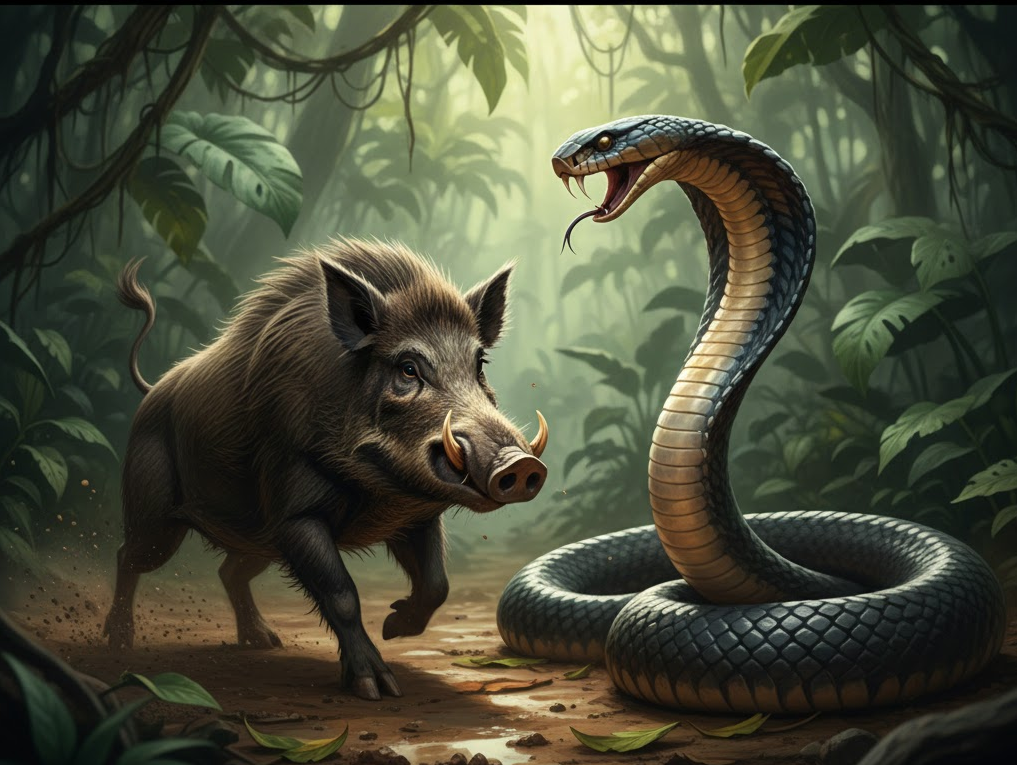
Contender 1: King Cobra
The king cobra stands as the longest venomous snake on Earth, reaching lengths up to 18 feet. This reptile weighs between 12 to 20 pounds despite its impressive length. Its slender body allows quick movement through forest floors and up into trees.
The snake’s venom delivery system represents its primary weapon. Two hollow fangs inject a potent neurotoxic venom that attacks the nervous system of prey. A single bite contains enough venom to kill an elephant or 20 adult humans. The venom works fast, shutting down breathing muscles within 30 minutes.
Beyond venom, the king cobra displays intimidating defensive behavior. When threatened, it raises the front third of its body off the ground, sometimes reaching eye level with a standing human. The snake spreads its iconic hood by extending ribs behind its head. This display makes the cobra appear larger and more dangerous to potential threats.
The reptile’s speed on the ground reaches about 12 miles per hour in short bursts. Its excellent vision helps track moving prey from up to 330 feet away. The forked tongue constantly samples air particles, feeding chemical information to the Jacobson’s organ for detecting prey and danger.
Fun fact: The king cobra is the only snake species that builds a nest for its eggs, and the mother guards them fiercely until they hatch, refusing to eat for the entire two-month incubation period.
Contender 2: Pig
Domestic pigs and their wild cousins, the boars, pack serious fighting capabilities beneath their common appearance. An adult wild boar weighs between 150 to 300 pounds, with some exceptional males reaching 400 pounds. They stand about 3 feet tall at the shoulder and measure 5 to 6 feet in length.
Their most dangerous weapons are razor-sharp tusks that grow continuously throughout their lives. Lower canine teeth curve upward, forming tusks that can reach 3 inches in domestic pigs and up to 6 inches in wild boars. These tusks slash upward in combat, causing deep wounds to attackers. Male boars sharpen their tusks by grinding them against upper teeth.
Pig skin provides exceptional natural armor. A thick layer of subcutaneous fat sits beneath skin that can be over an inch thick in some areas. Wild boars develop an additional protective shield called a “shield plate,” made of hardened cartilage and scar tissue on their shoulders. This armor protects vital organs during fights with predators and rival boars.
Their bite force measures around 500 PSI, strong enough to crack nuts and crush bones. Pigs are omnivores with powerful jaw muscles designed for both grinding plants and tearing meat. When cornered or protecting young, they attack aggressively rather than flee.
Speed surprises most people when it comes to pigs. Wild boars sprint up to 30 miles per hour over short distances. Their compact, muscular build gives them excellent acceleration. They change direction quickly, making them difficult targets for predators.
Intelligence ranks pigs among the smartest animals on Earth, comparable to dogs and some primates. They learn from experience, remember dangerous situations, and adapt their behavior accordingly. This mental edge helps them survive encounters with various predators across their range.
Fun fact: Pigs cannot sweat because they have very few sweat glands, which is why they roll in mud to cool down, and their “dirty” reputation is actually a clever cooling strategy that also protects their skin from sunburn and parasites.
Head-to-Head
| Category | King Cobra | Pig |
|---|---|---|
| Size | Up to 18 feet long | 5-6 feet long, 3 feet tall |
| Weight | 12-20 pounds | 150-400 pounds |
| Speed | 12 mph | 30 mph |
| Bite Force | 150 PSI | 500 PSI |
| Key Strength | Deadly neurotoxic venom | Thick skin armor and tusks |
| Main Weakness | Fragile body, vulnerable to trampling | Vulnerable neck and underbelly |
| Offense Tools | Venomous fangs, speed, reach | Tusks, powerful bite, charging attacks |
| Defense Tools | Speed, intimidation display, agility | Thick skin, fat layer, shield plate |
| Combat Strategy | Strike and retreat, wait for venom | Aggressive charge, slash with tusks |
King Cobra vs. Pig: The Showdown
The encounter begins when a foraging pig roots through leaf litter near a termite mound where a king cobra has taken shelter. The snake detects vibrations through the ground as the pig approaches. It raises its head, sampling the air with rapid tongue flicks.
The pig stops digging when it notices the raised serpent five feet away. Both animals freeze. The cobra spreads its hood wide, hissing loudly to warn off this massive intruder. The pig grunts and lowers its head, recognizing a threat.
The cobra strikes first. It lunges forward with incredible speed, fangs extended, aiming for the pig’s snout. The pig jerks its head sideways at the last moment. The fangs catch the pig’s thick jowl instead of the intended target. The snake injects venom but struggles to achieve deep penetration through the dense skin and fat layer.
Pain and anger trigger the pig’s attack response. It charges forward with a explosive burst of speed. The cobra tries to retreat but cannot match the pig’s acceleration. A 250-pound body slams into the snake’s midsection. The impact sends the cobra tumbling sideways across the forest floor.
The snake recovers quickly, attempting another strike. This time the fangs find purchase on the pig’s front leg. More venom flows into the wound. The pig squeals but shows no signs of slowing. Its thick blood vessels and layers of fat dilute and slow the venom’s spread through its system.
The pig retaliates with devastating efficiency. It catches the cobra’s body behind the head with a powerful bite. The 500 PSI jaw pressure crushes vertebrae and damages the snake’s delicate internal structure. The cobra writhes violently, wrapping its body around the pig’s head and neck.
This proves to be a fatal mistake. The constriction annoys the pig but cannot choke an animal with such a thick, muscular neck. The pig shakes its head violently, like a dog with a toy. The cobra’s spine suffers multiple fractures from the whipping motion.
Breaking free from the coils, the pig uses its primary weapon. It slashes upward with its tusks, catching the cobra’s body mid-length. The sharp tusks tear through scales and muscle, creating a deep gash. Blood flows from the wound as the snake’s movements become uncoordinated.
The venom begins affecting the pig after several minutes. Its movements slow slightly, and muscle tremors appear in the bitten leg. However, the damage to the cobra is catastrophic. Multiple spinal injuries prevent coordinated movement. The gash from the tusks continues bleeding.
The pig delivers a final attack. It tramples the injured snake, using its full weight to crush the cobra’s body. The snake’s ribs collapse under the pressure. Internal organs rupture. Within moments, the cobra stops moving entirely.
The pig survives the encounter. The venom causes temporary weakness and pain, but the animal’s size, thick tissues, and robust cardiovascular system prevent the toxin from reaching lethal concentrations in vital organs. After an hour of rest, the pig resumes foraging, leaving the dead cobra behind.
The pig wins this fight with approximately 80 percent certainty. Its physical armor, superior size, and crushing power overwhelm the cobra’s venom advantage in most scenarios.
King Cobra vs. Pig: Who Would Win?
The pig emerges victorious in most encounters between these two animals. Its thick protective skin significantly reduces the effectiveness of the cobra’s venomous bite, while its tusks and trampling ability can quickly inflict fatal injuries on the snake’s fragile body.
Points to note:
• A bite to the pig’s snout, eyes, or mouth could deliver enough venom to kill the pig, giving the cobra a small chance of victory if it lands a perfect strike
• Wild boars actively hunt and eat snakes as part of their omnivorous diet, so they have natural experience dealing with serpent attacks
• Younger or smaller pigs under 100 pounds face much higher risk from cobra venom due to their smaller body mass and thinner skin
• The cobra’s survival strategy relies on ambush and retreat, but the pig’s speed and aggressive nature prevent easy escape once the fight begins
• Domestic pigs have less developed defensive behaviors than wild boars, which could shift the odds slightly in the cobra’s favor
• The fight outcome depends heavily on where the initial bite lands, as some areas of the pig’s body offer less protection than others
• Both animals would normally avoid each other, as king cobras prefer to hunt other snakes and small mammals while pigs focus on roots, insects, and plant matter