
The king cobra strikes fear into the hearts of most creatures. This deadly serpent can deliver enough venom to kill an elephant. Yet one small predator regularly challenges and defeats this giant snake.
The mongoose has earned a legendary reputation as a snake killer. These quick and fearless hunters possess unique abilities that make them nearly immune to cobra venom. This article explores the physical traits, fighting abilities, and tactical advantages of both animals to determine which creature would likely win in a direct battle.
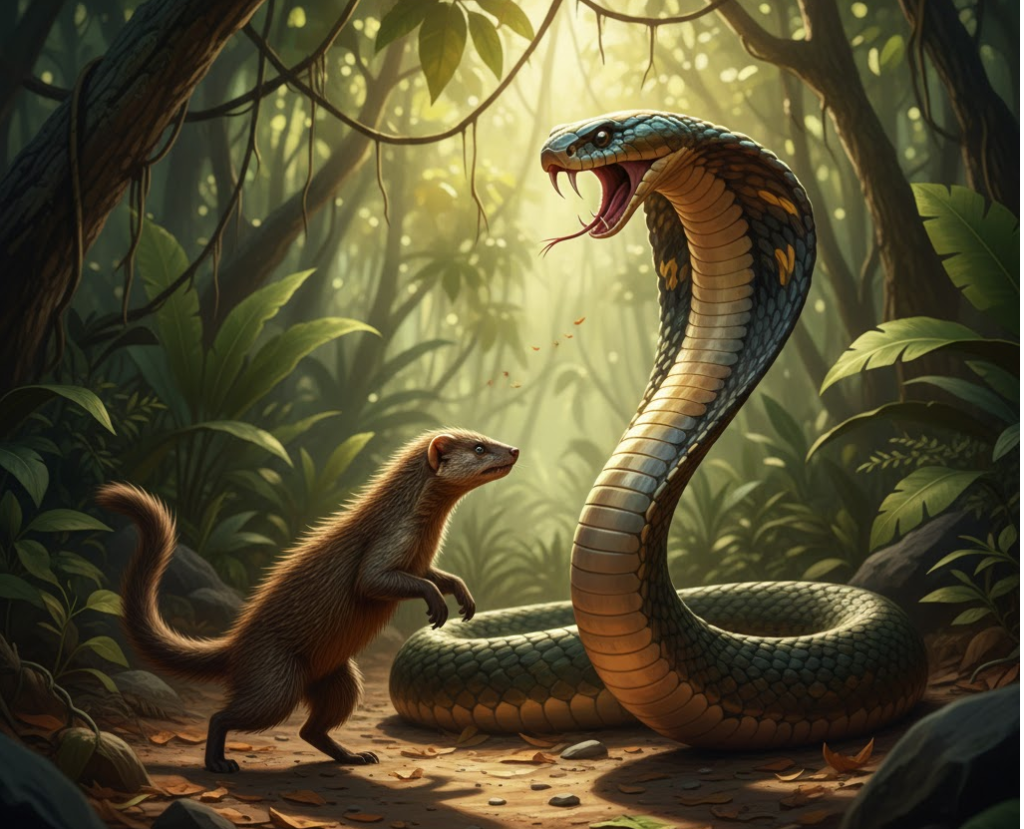
Contender 1: King Cobra
The king cobra stands as the longest venomous snake on Earth, reaching lengths of up to 18 feet. This massive serpent can raise the front third of its body off the ground, lifting itself to eye level with a standing human. The iconic hood spreads wide when threatened, making the snake appear even larger and more intimidating to potential predators.
Venom serves as the king cobra’s primary weapon. A single bite can inject up to 7 milliliters of neurotoxic venom, enough to kill 20 adult humans or a full-grown elephant. The venom attacks the nervous system, causing paralysis, respiratory failure, and death within hours if left untreated. Unlike many other snakes that bite and release, king cobras often hold on during their strike, pumping more venom into their victim.
The cobra’s fangs measure about half an inch long. These hollow, needle-like teeth connect directly to venom glands at the back of the skull. The snake can control how much venom it injects, sometimes delivering dry bites as warnings. This ability to regulate venom flow shows remarkable evolutionary sophistication.
Speed and accuracy make the king cobra’s strike particularly dangerous. The snake can lunge forward at speeds reaching 12 miles per hour, covering a distance of up to one-third of its body length in a fraction of a second. This lightning-fast attack leaves little time for prey to react or escape.
Fun fact: King cobras are the only snakes known to build nests for their eggs, and females guard these nests aggressively for up to three months, refusing to eat during this entire period and attacking anything that approaches.
Contender 2: Mongoose
The mongoose appears unimpressive at first glance. Most species measure between 12 to 24 inches in length and weigh only 2 to 4 pounds. This small carnivore belongs to the family Herpestidae and comprises about 34 different species spread across Africa and Asia. The Indian grey mongoose, famous for its battles with cobras, typically weighs around 2 pounds and stretches 15 inches from nose to tail.
Thick fur and tough skin provide the mongoose with excellent defense against snake bites. The fur acts as padding, making it difficult for fangs to penetrate to the skin. Below this protective coat lies particularly thick skin that further reduces the chances of successful venom injection. Even when bitten, the mongoose possesses a secret weapon that sets it apart from nearly all other mammals.
Genetic mutations grant the mongoose partial immunity to snake venom. Special receptors in the mongoose’s body prevent cobra neurotoxins from binding to nerve cells. This resistance means a bite that would kill most animals merely slows down a mongoose temporarily. The animal can survive venom doses that would prove fatal to creatures many times its size.
Lightning reflexes make the mongoose a formidable opponent. These hunters can react to threats in just 15 milliseconds, faster than the blink of a human eye. Quick twitch muscle fibers allow for sudden changes in direction, helping the mongoose dodge snake strikes with acrobatic precision. This speed combines with fearless aggression to create a dangerous predator.
Sharp teeth and powerful jaws give the mongoose serious offensive capabilities. The animal possesses 40 teeth, including long canines designed for gripping and tearing. A mongoose aims for the back of a snake’s head, crushing the skull with repeated bites. The jaw muscles generate enough force to crack through scales and bone.
Intelligence and experience play crucial roles in mongoose hunting success. These animals learn snake-fighting techniques from their mothers and refine their skills throughout their lives. Older mongooses show remarkable tactical awareness, using feints and misdirection to tire out their serpent opponents before moving in for the kill.
Fun fact: Mongooses are completely immune to scorpion stings and can eat the venomous arachnids without any ill effects, making them one of the few animals that can safely hunt these dangerous creatures.
Head-to-Head
| Category | King Cobra | Mongoose |
|---|---|---|
| Size | Up to 18 feet long | 12-24 inches long |
| Weight | 12-20 pounds | 2-4 pounds |
| Speed | Strike speed: 12 mph | Movement speed: 20 mph |
| Bite Force | 150 PSI | 230 PSI |
| Key Strength | Lethal neurotoxic venom | Partial venom immunity |
| Main Weakness | Vulnerable skull and neck | Small size limits endurance |
| Offense Tools | Venomous fangs, constriction | Sharp teeth, agility |
| Defense Tools | Size, hood display, venom | Speed, thick fur, venom resistance |
| Combat Strategy | Strike and envenom quickly | Dodge and attack the head |
King Cobra vs. Mongoose: The Showdown
The king cobra detects movement in the grass ahead. Its forked tongue flicks rapidly, tasting the air for chemical signals. A mongoose emerges from the undergrowth, eyes locked on the serpent. The cobra immediately raises its front body, spreading its hood wide. A loud hiss erupts from its throat, a warning that would send most predators fleeing.
The mongoose ignores the threat display. It begins circling, moving with quick, jerky motions. The cobra turns to keep its head facing the small predator, following each movement with deadly focus. Suddenly, the snake strikes with explosive speed, fangs extended and dripping with venom.
The mongoose dodges left with blinding quickness. The cobra’s head shoots past, missing by inches. Before the snake can retract, the mongoose darts in and bites at the cobra’s neck. Sharp teeth tear through scales but fail to find a firm grip. The cobra whips its body around, forcing the mongoose to leap backward.
Both animals reset, eyes locked in concentration. The cobra strikes again, this time aiming lower. The mongoose jumps straight up, and the fangs pass harmlessly beneath. Landing on the cobra’s back, the small predator scrambles forward toward the head. The cobra thrashes violently, throwing the mongoose off before it can deliver a killing bite.
The mongoose lands on its feet and immediately charges back in. The cobra strikes three times in rapid succession. Each attack misses as the mongoose weaves and dodges with incredible reflexes. The snake begins to tire from the constant striking and the effort of keeping its heavy body raised.
Sensing weakness, the mongoose presses its advantage. It feints left, drawing another strike, then rushes in from the right. Teeth sink into the back of the cobra’s skull. The snake shakes its head violently, but the mongoose holds firm, jaws locked. More bites follow, each one weakening the serpent further.
The cobra manages one last desperate strike. Fangs pierce the mongoose’s shoulder, injecting a dose of venom that would kill most animals within minutes. The mongoose releases briefly, then attacks again with renewed fury. The partial immunity bought precious time.
Blood flows from multiple wounds on the cobra’s head and neck. The snake’s movements become sluggish, the skull fracturing under repeated bites. Within fifteen minutes of the battle’s start, the cobra lies motionless. The mongoose, moving slightly slower from the venom in its system, begins feeding on its hard-won meal.
The mongoose wins this battle roughly 80 percent of the time. Superior speed, venom resistance, and targeted attack strategy overcome the cobra’s size and lethal poison.
King Cobra vs. Mongoose: Who Would Win?
The mongoose would most likely win this fight due to its partial venom immunity and superior agility. These advantages allow the small predator to dodge cobra strikes while repeatedly attacking the snake’s vulnerable head until achieving victory.
Points to note:
- Young or inexperienced mongooses face higher risk of defeat, as proper technique requires years of learning and practice
- Exceptionally large king cobras weighing over 20 pounds can overpower mongooses through sheer size and strength
- The fight outcome depends heavily on the first few exchanges, as a lucky cobra strike could inject enough venom to slow even a resistant mongoose
- Mongooses typically avoid king cobras when other food sources are available, preferring easier and safer prey
- The cobra’s best chance of winning involves landing an early bite to the mongoose’s face or neck, where venom absorption happens faster
- Environmental factors like confined spaces favor the cobra by limiting the mongoose’s ability to dodge and maneuver
- A well-fed mongoose fights more cautiously than a hungry one, sometimes choosing to retreat rather than risk injury
- King cobras that have recently used their venom on other prey carry less toxin, reducing their offensive capability
- Multiple mongooses working together can defeat even the largest king cobras with minimal risk