
Two of nature’s most feared predators stand ready for battle. The king cobra brings deadly venom and lightning strikes. The Komodo dragon counters with crushing jaws and toxic bacteria.
This matchup pits a snake against a giant lizard in a clash of different hunting styles. Readers will learn about each animal’s weapons, weaknesses, and fighting tactics. By the end, the likely victor will emerge based on science and real hunting behaviors.
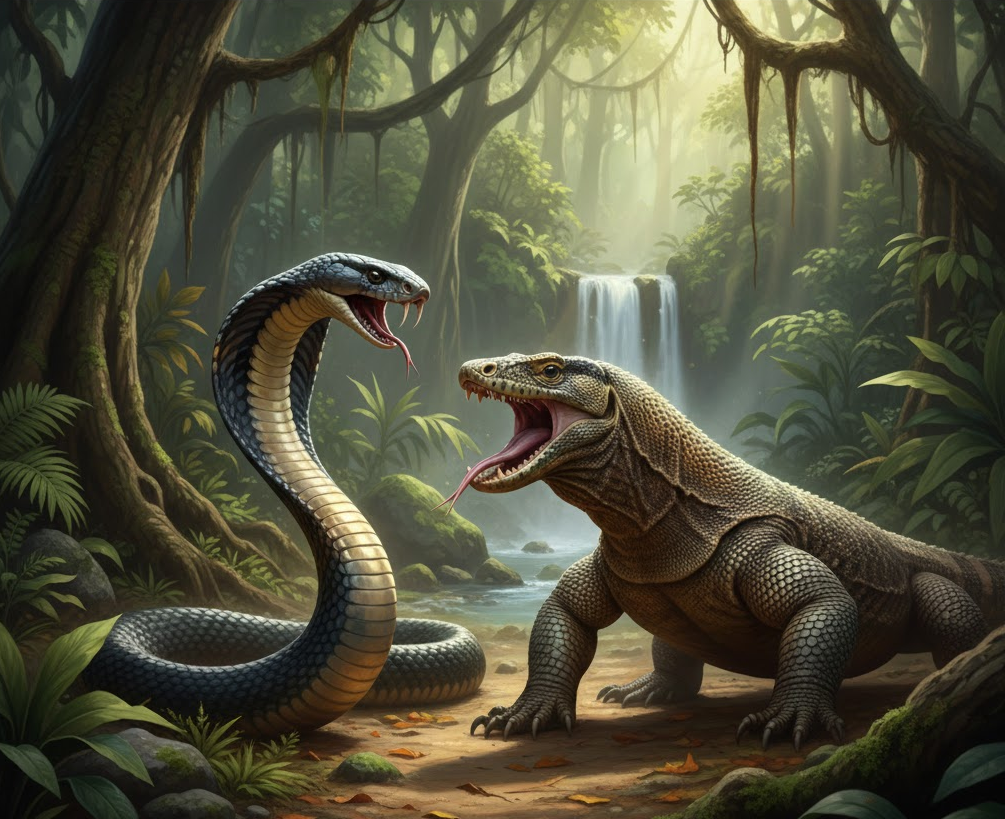
Contender 1: King Cobra
The king cobra stands as the longest venomous snake on Earth, reaching lengths of 18 feet. Males typically grow larger than females, with some exceptional specimens stretching beyond 19 feet. This massive serpent can weigh up to 20 pounds, making it surprisingly heavy for a snake.
Speed defines the cobra’s hunting success. These snakes strike with incredible accuracy at speeds reaching 12 miles per hour. Their fangs measure half an inch long but deliver enough venom to kill an elephant. A single bite contains up to 7 milliliters of neurotoxic venom.
The hood serves as both warning display and psychological weapon. When threatened, the king cobra raises the front third of its body off the ground. This creates an imposing height of up to 6 feet, allowing the snake to look a human in the eye. The expanded ribs form the iconic hood that signals danger.
Defense comes from excellent eyesight and quick reflexes. The cobra can detect movement from 300 feet away. Its scales provide limited protection against bites, but the snake’s agility keeps it safe. The ability to move while keeping the front portion raised gives it 360-degree awareness.
Fun fact: King cobras are the only snakes that build nests for their eggs, and females guard them fiercely for up to three months, refusing to eat during this entire period.
Contender 2: Komodo Dragon
The Komodo dragon claims the title of largest living lizard species. Adult males reach lengths of 10 feet and weigh between 150 to 200 pounds. Some exceptional individuals have tipped scales at nearly 365 pounds. Their muscular build and low center of gravity make them formidable ground fighters.
Powerful jaws contain 60 serrated teeth designed to rip flesh. Each tooth measures up to an inch long and curves backward like a shark’s. The bite force reaches 600 PSI, strong enough to crush bones. These teeth get replaced constantly throughout the dragon’s life.
Venom glands in the lower jaw add another deadly dimension. Scientists discovered that Komodo dragons produce venom containing anticoagulants and toxins that lower blood pressure. This venom prevents wounds from clotting and sends prey into shock. The combination of venom and bacteria in their mouths creates a deadly cocktail.
Their thick, armored skin acts as natural body armor. Tiny bones called osteoderms lie beneath the scales, providing protection against bites and scratches. This defensive layer covers the entire body except the belly. The tail alone can be used as a weapon, capable of knocking down prey.
Speed surprises most observers. Komodo dragons sprint at speeds up to 13 miles per hour in short bursts. Their endurance allows them to track wounded prey for miles. Sharp claws on powerful legs help them dig, climb, and slash at opponents.
Patience defines their hunting strategy. These lizards can wait motionless for hours near game trails. Their yellow forked tongues detect scents from miles away, leading them to carrion or living prey. Once they lock onto a target, they rarely give up the hunt.
Fun fact: Komodo dragons can reproduce through parthenogenesis, meaning females can lay fertile eggs without mating, producing only male offspring through this process.
Head-to-Head
| Feature | King Cobra | Komodo Dragon |
|---|---|---|
| Size | Up to 18 feet long | Up to 10 feet long |
| Weight | Up to 20 pounds | 150-200 pounds |
| Speed | 12 mph | 13 mph |
| Bite Force | Low (designed for venom delivery) | 600 PSI |
| Key Strength | Potent neurotoxic venom | Armored body and powerful bite |
| Main Weakness | Fragile body structure | Vulnerable belly |
| Offense Tools | Venomous fangs, speed, striking reach | Venom, teeth, claws, tail |
| Defense Tools | Agility, hood display, height advantage | Thick scaled armor, osteoderms |
| Combat Strategy | Quick strikes from elevated position | Patient stalking, crushing bites |
King Cobra vs. Komodo Dragon: The Showdown
The encounter begins in a rocky clearing where both predators cross paths. The king cobra, stretched across sun-warmed stones, detects heavy footsteps approaching. The Komodo dragon emerges from thick brush, its tongue flicking to taste the air. Both animals pause, sizing up the unexpected threat.
The cobra responds first. Its front third rises smoothly off the ground, hood spreading wide in a display of dominance. The snake now stands nearly five feet tall, swaying slightly as it tracks the lizard’s movements. A low hiss escapes as the cobra warns the intruder to back away.
The dragon shows no fear. Moving laterally, it circles the cobra with surprising speed. Its muscular legs carry the 180-pound body with disturbing efficiency. The lizard’s tail sweeps behind it, ready to provide balance or serve as a weapon.
The cobra strikes without warning. Its head shoots forward like a spring-loaded spear, fangs bared. The dragon’s reflexes save it. A quick sideways lunge puts the lizard just beyond reach. The cobra’s fangs snap shut on empty air.
Both predators reset their positions. The cobra maintains its elevated stance, knowing that staying high gives it advantages. The dragon continues circling, patient and methodical. Its yellow eyes never leave the serpent’s head.
The dragon lunges suddenly, jaws gaping wide. The cobra strikes downward, fangs connecting with the dragon’s snout. Venom pumps into the tough skin. The dragon’s jaws clamp onto the cobra’s body just behind the head. Teeth sink deep into muscle and bone.
The cobra thrashes violently. Its powerful body coils around the dragon’s neck and front legs. Constriction begins even as venom courses through the lizard’s bloodstream. The dragon shakes its head viciously, the serrated teeth sawing through the cobra’s flesh.
Weight becomes the deciding factor. The dragon uses its 180 pounds to force the cobra against the ground. The snake’s vertebrae crack under the pressure. Despite injecting a full dose of venom, the cobra’s neurotoxins work too slowly on the dragon’s massive body.
The dragon’s jaws maintain their grip. Each shake tears more tissue. The cobra’s movements weaken as blood loss mounts. The venom begins affecting the dragon, causing dizziness and reduced blood pressure. The lizard staggers but refuses to release its prey.
Minutes pass. The cobra’s coils loosen as strength fades. The dragon’s powerful neck muscles continue the assault. One final violent shake breaks the cobra’s spine completely. The snake goes limp.
The dragon releases its grip and steps back. Blood drips from its snout where the cobra’s fangs penetrated. The venom causes the lizard to move sluggishly. It will feel sick for days, possibly weeks. The wound may become infected.
The Komodo dragon wins this battle roughly 7 out of 10 times. Its armor, weight advantage, and crushing bite overcome the cobra’s venom in most scenarios.
King Cobra vs. Komodo Dragon: Who Would Win?
The Komodo dragon would most likely win this fight due to its superior weight, armored body, and devastating bite force. While the king cobra’s venom is deadly, it acts too slowly to stop the dragon before the lizard’s crushing jaws inflict fatal damage.
Points to note:
- The cobra’s chances improve significantly if it lands a perfect strike on the dragon’s vulnerable belly or eyes
- These animals would rarely meet in nature since king cobras live in forests of South and Southeast Asia while Komodo dragons inhabit only a few Indonesian islands
- A younger, smaller Komodo dragon (under 100 pounds) would have much lower odds against a large king cobra
- Environmental factors matter greatly, with the cobra performing better in areas with trees or rocks that allow quick escape routes
- The dragon’s ability to track and follow wounded prey means even if the cobra escapes after biting, the dragon might hunt it down later
- Temperature affects both animals’ performance, with the cold-blooded dragon becoming sluggish in cooler conditions while the cobra remains more active
- If the cobra manages to avoid the first rush and strike multiple times, accumulated venom could tip the scales
- The dragon’s venom and bacteria create a double threat that weakens the cobra even if the snake survives the initial encounter