
Two of the planet’s most feared serpents command respect across continents. The king cobra rules the forests of Asia while the black mamba terrorizes the savannas of Africa. Both snakes kill with deadly venom and lightning-fast strikes.
This analysis examines their weapons, defenses, and hunting styles. Readers will discover which snake holds the advantage when these two apex predators meet in combat.
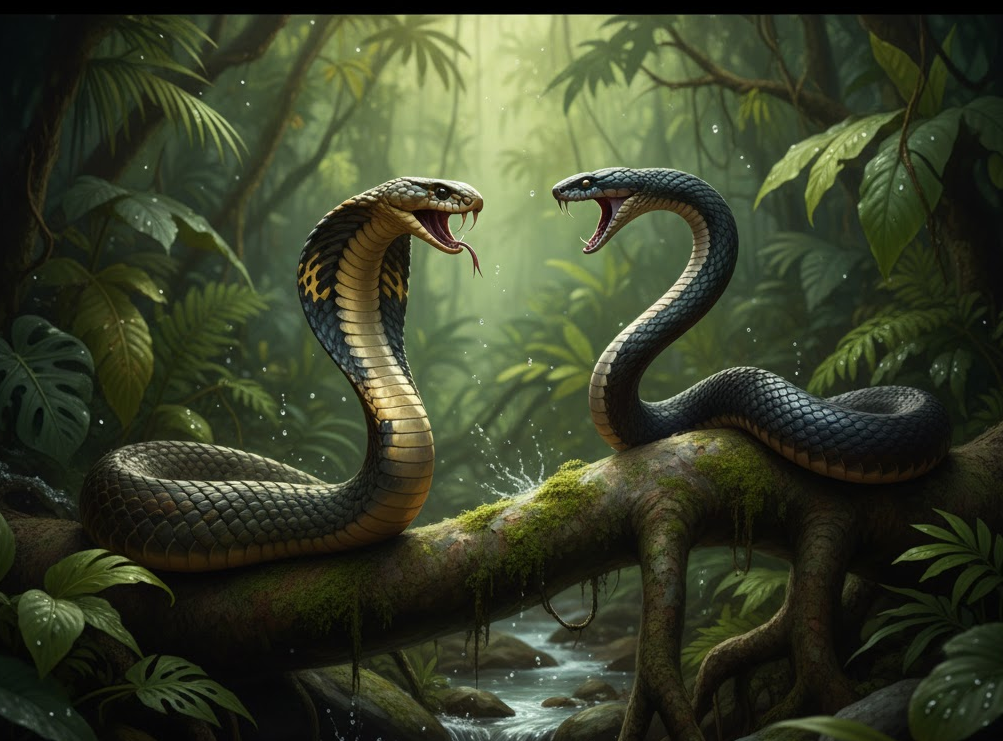
Contender 1: King Cobra
The king cobra stretches up to 18 feet long, making it the longest venomous snake on Earth. This massive serpent weighs between 12 and 20 pounds despite its impressive length. Its slender build allows for quick movement through dense jungle vegetation.
Olive-green, tan, or black scales cover its body with lighter crossbands along the length. When threatened, the cobra raises up to one-third of its body off the ground. This defensive posture can lift the snake’s head 6 feet high, putting it at eye level with an adult human.
The hood is the king cobra’s signature feature. Special ribs extend outward when the snake feels danger, creating an intimidating display. Yellow and black markings on the hood serve as a warning to potential threats.
Venom delivery happens through two fixed fangs at the front of the mouth. Each fang measures about half an inch long. A single bite injects enough neurotoxic venom to kill an elephant or 20 adult humans.
Fun fact: King cobras are the only snakes that build nests for their eggs, and females guard them aggressively for up to three months without eating.
Contender 2: Black Mamba
The black mamba reaches lengths of 8 to 14 feet, ranking as Africa’s longest venomous snake. Adults typically weigh 3.5 pounds, much lighter than their Asian cousin. This snake’s name comes from the black color inside its mouth, not its actual skin color.
Gray, brown, or olive scales cover the body with a lighter underside. The head is coffin-shaped and distinctly separate from the neck. Small eyes with round pupils give the mamba excellent vision for tracking prey and detecting threats.
Speed sets this snake apart from almost all other serpents. The black mamba moves at 12 miles per hour across open ground. This makes it the fastest snake in the world. Short bursts can reach even higher speeds when the snake feels cornered.
Fixed fangs similar to the king cobra’s deliver the deadly payload. These fangs sit at the front of the mouth and fold back when not in use. The venom contains both neurotoxins and cardiotoxins that attack the nervous system and heart simultaneously.
A black mamba strikes with terrifying accuracy and speed. The snake can hit a target multiple times in rapid succession. Each bite injects around 100-120 mg of venom, though only 10-15 mg is enough to kill an adult human. Without antivenin treatment, death occurs within 7 to 15 hours.
Fun fact: Black mambas can strike at targets up to 40% of their body length away, and they’re capable of delivering up to 12 consecutive bites in a single attack.
Head-to-Head
| Feature | King Cobra | Black Mamba |
|---|---|---|
| Size | 10-18 feet | 8-14 feet |
| Weight | 12-20 pounds | 3.5 pounds |
| Speed | 12 mph | 12 mph |
| Bite Force | Moderate | Moderate |
| Key Strength | Superior size and venom volume | Extreme speed and aggression |
| Main Weakness | Slower to strike repeatedly | Smaller size and lighter build |
| Offense Tools | Neurotoxic venom, powerful strikes, intimidation | Multiple rapid strikes, mixed venom, agility |
| Defense Tools | Hood display, size advantage, venom resistance | Speed, escape ability, warning displays |
| Combat Strategy | Intimidate first, strike with force | Attack rapidly and repeatedly |
King Cobra vs. Black Mamba: The Showdown
The encounter begins when both snakes cross paths in a hypothetical neutral territory. The king cobra immediately raises its front body, extending to nearly 6 feet tall. Its hood flares wide as a hiss escapes from its throat. The black mamba responds by opening its inky black mouth in a threat display.
Neither snake wants this fight. Both serpents recognize the other as a dangerous opponent. The mamba makes the first aggressive move, darting forward with its superior ground speed.
The cobra holds its elevated position and watches the approaching threat. When the mamba enters striking range, the cobra lunges downward. Its longer reach allows it to strike first. Fangs sink into the mamba’s body just behind the head.
Venom flows into the wound, but the mamba doesn’t retreat. Pain and survival instinct trigger an explosive response. The lighter snake strikes back three times in rapid succession. Each bite lands on the cobra’s thick body.
Both serpents pull back to reassess. The king cobra’s venom starts working on the mamba’s nervous system. Muscle control begins to weaken. The cobra feels the mamba’s venom too, but its natural resistance to snake venom provides some protection.
The mamba tries another attack, moving with less coordination than before. The king cobra strikes again, this time clamping down and holding on. More venom pumps into the mamba’s system. The smaller snake manages one more defensive bite before its movements slow dramatically.
Within minutes, the black mamba’s body stops responding to its commands. The neurotoxins have shut down vital functions. The king cobra releases its grip and watches its opponent succumb to the venom. The cobra survives, though weakened by the mamba’s toxic bites.
The king cobra wins this battle approximately 70% of the time. Its size advantage, longer reach, and partial venom resistance give it the edge.
King Cobra vs. Black Mamba: Who Would Win?
The king cobra claims victory in most encounters between these two venomous serpents. Superior size, greater venom volume, and natural resistance to other snake venoms provide the deciding advantages.
Points to note:
- The black mamba’s speed and multiple-strike ability could turn the fight if it lands several clean bites before the cobra connects
- These snakes would never meet naturally since king cobras live in Asia and black mambas inhabit Africa
- Temperature and terrain would affect each snake’s performance, with the cobra preferring forests and the mamba favoring open areas
- A larger black mamba against a smaller king cobra might shift the outcome closer to 50-50
- King cobras actively hunt and eat other snakes, giving them experience that black mambas lack
- Both snakes typically avoid confrontation and would rather escape than fight each other
- The cobra’s partial immunity to snake venom evolved specifically because it preys on other venomous snakes
- Environmental stress, hunger, or recent injuries would significantly impact either snake’s fighting ability