
Two apex predators from completely different worlds rarely cross paths in nature. The grizzly bear rules the mountains and forests of North America with raw power and aggression. The anaconda dominates the swamps and rivers of South America through stealth and crushing force.
This article explores what would happen if these two giants somehow met in combat. Readers will learn about each animal’s weapons, weaknesses, and fighting style. The analysis reveals which predator holds the advantage and why.
Contender 1: Grizzly Bear
The grizzly bear stands as one of North America’s most powerful land predators. Adult males reach heights of 8 feet when standing upright and possess massive muscular frames built for both speed and strength. Their bodies are covered in thick fur that ranges from blonde to dark brown, with distinctive silver-tipped guard hairs that give them their “grizzled” appearance.
These bears possess enormous physical power concentrated in their upper body. Their shoulders contain a massive muscle hump that drives their front limbs with incredible force. A single swipe from a grizzly’s paw can crush a skull or break the spine of large prey animals. Each paw comes equipped with five curved claws that measure up to 4 inches long.
The grizzly’s jaws deliver devastating bite force measured at roughly 1,160 PSI. Their teeth include large canines for gripping and tearing, along with powerful molars designed for crushing bone. This dental arrangement allows them to kill and consume prey ranging from small rodents to elk. The bear’s skull is incredibly thick and dense, protecting its brain from impacts.
Speed makes the grizzly even more dangerous than its size suggests. These massive animals can sprint at speeds reaching 35 miles per hour over short distances. Their agility allows them to change direction quickly and even climb trees when needed. This combination of speed and power makes them effective ambush predators.
Fun fact: Grizzly bears possess one of the best senses of smell in the animal kingdom, able to detect food sources from over 20 miles away and even smell carcasses buried under several feet of snow.
Contender 2: Anaconda
The green anaconda claims the title of the world’s heaviest snake and one of the longest. Adult females reach lengths of 20 to 30 feet and can weigh over 550 pounds. Their bodies are pure muscle wrapped in thick, scaly skin with a camouflage pattern of olive green with black oval spots. Males are significantly smaller, rarely exceeding 15 feet in length.
The anaconda’s primary weapon is constriction, a killing method that involves wrapping coils around prey and squeezing. Each time the victim exhales, the snake tightens its grip further. This creates a ratcheting effect where breathing becomes impossible and blood flow to vital organs stops. The pressure generated by an anaconda’s coils can exceed 90 PSI, enough to stop a heart or collapse lungs.
These snakes possess rows of backward-facing teeth that curve inward like hooks. While not venomous, these teeth serve to grip prey and prevent escape once the snake latches on. An anaconda’s jaw can unhinge and stretch to remarkable dimensions, allowing it to swallow prey much larger than its head. The teeth work together with powerful jaw muscles to pull prey deeper into the throat.
Anacondas are built for aquatic ambush hunting. They spend most of their time in slow-moving rivers and swamps, often remaining motionless for hours. Their eyes and nostrils sit on top of their heads, allowing them to stay almost completely submerged while watching for prey. This positioning gives them excellent camouflage in murky water.
The snake’s scales provide both protection and sensory input. Thick scales along the belly help the anaconda grip surfaces and move across different terrain. Special heat-sensing pits along the jaw line detect the body heat of warm-blooded animals, even in complete darkness. This thermal vision makes them deadly nocturnal hunters.
Their muscular bodies contain over 10,000 individual muscles that work together to create crushing force. Unlike mammals, snakes have ribs along most of their body length, each connected to flexible muscles. This structure allows the anaconda to wrap around objects of various shapes and sizes while maintaining constant pressure. The tail acts as an anchor point, bracing against solid objects to increase leverage.
Fun fact: Anacondas can hold their breath underwater for up to 10 minutes and have been known to wait in ambush beneath the surface for hours, requiring very little oxygen due to their slow metabolism.
Head-to-Head
| Attribute | Grizzly Bear | Anaconda |
|---|---|---|
| Size | 8 feet tall (standing) | 20-30 feet long |
| Weight | 400-800 pounds | 300-550 pounds |
| Speed | 35 mph (on land) | 10 mph (in water), 5 mph (on land) |
| Bite Force | 1,160 PSI | 90 PSI (constriction pressure) |
| Key Strength | Raw power and claws | Constriction and flexibility |
| Main Weakness | Limited water mobility | Slow movement on land |
| Offense Tools | Claws, teeth, strength | Coils, teeth, stamina |
| Defense Tools | Thick hide, muscle mass | Scales, flexibility |
| Combat Strategy | Aggressive frontal assault | Ambush and wrap |
Grizzly Bear vs. Anaconda: The Showdown
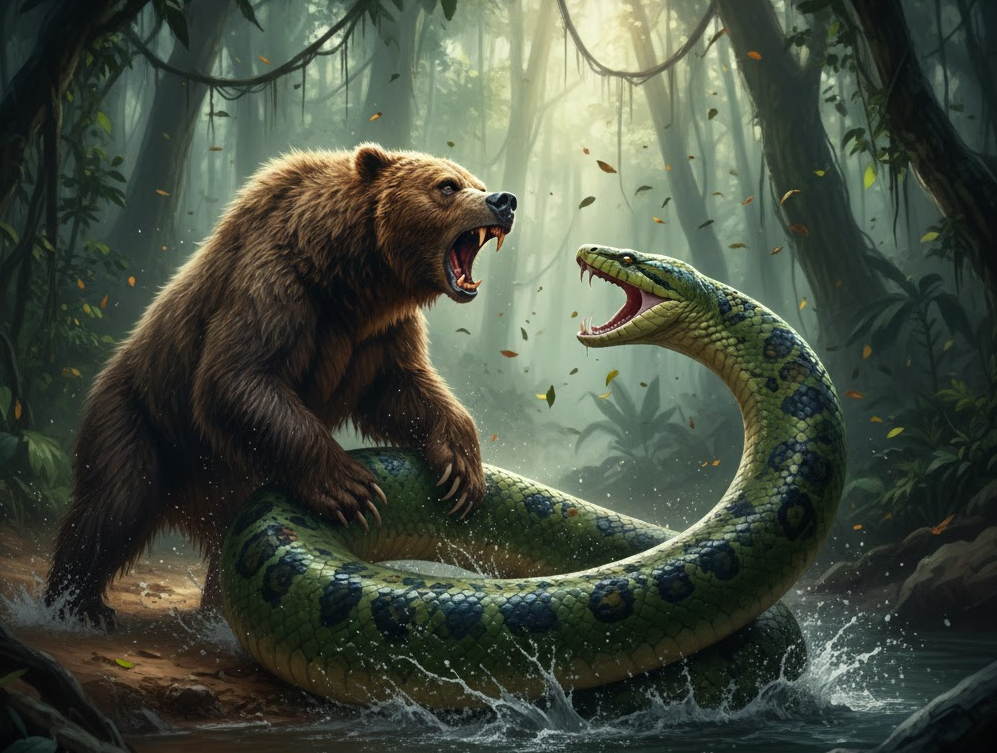
The encounter begins at the edge of a shallow river where both animals have come to hunt. The grizzly spots movement in the water and wades in, looking for salmon. The anaconda, coiled beneath the murky surface, detects the bear’s heat signature. This sets the stage for an explosive confrontation.
The snake strikes first, lunging from the water with its mouth open wide. Its teeth sink into the bear’s front leg as it attempts to wrap its body around the limb. The grizzly roars in surprise and pain, immediately recognizing the threat. With tremendous force, the bear swings its trapped leg upward, lifting the snake partially out of the water.
The anaconda’s coils begin wrapping around the bear’s front quarters, seeking to immobilize the powerful forelimbs. Each squeeze tightens the grip as the snake tries to reach around the bear’s chest. The grizzly responds with savage fury, using its free paw to claw at the snake’s thick body. The claws tear through scales, leaving deep gashes that bleed into the water.
Pain and rage drive the bear to a new tactic. It drops to all fours and begins rolling, using its massive weight advantage. The twisting motion forces the anaconda to readjust its coils constantly, preventing it from achieving a full constriction. Each roll slams hundreds of pounds of bear weight onto the snake’s body. The impacts crack ribs and damage internal organs.
The anaconda refuses to release its hold, instinctively knowing that letting go means certain death. Its coils reach the bear’s neck area, attempting to cut off blood flow to the brain. For a moment, the strategy shows promise. The bear’s movements slow slightly as pressure builds on major arteries. This proves to be the snake’s final offensive push.
The grizzly’s raw power proves decisive. Using its hind legs for leverage, the bear stands upright with the snake still attached. The sudden vertical position changes everything. Gravity works against the anaconda now, pulling its body weight downward and loosening the coils. The bear seizes this opportunity, biting down on the snake’s mid-section with its powerful jaws.
Bone crunches as the bear’s teeth penetrate deep into the anaconda’s body. The snake’s spine fractures under the crushing bite force. Its coils weaken dramatically, losing the strength needed to maintain constriction. The grizzly shakes its head violently, like a dog with a toy, further damaging the snake’s internal structure.
The anaconda makes one final attempt to reestablish its grip, but the damage is too severe. The bear tears free from the weakened coils and drops back to all fours. With methodical brutality, the grizzly uses its claws to rip open the snake’s body. Multiple swipes and bites ensure the anaconda cannot recover or escape.
Within minutes, the fight concludes. The bear stands victorious, though bleeding from multiple puncture wounds and bearing compression injuries from the snake’s coils. The anaconda lies motionless in the shallow water, its body broken in several places. The grizzly’s combination of superior land mobility, devastating bite force, and sheer aggression overwhelms the snake’s constriction strategy.
The grizzly bear wins this confrontation with roughly 85% certainty under these conditions. The bear’s advantages on land prove too significant for the anaconda to overcome.
Grizzly Bear vs. Anaconda: Who Would Win?
The grizzly bear emerges as the clear victor in this matchup due to its superior land mobility and devastating offensive weapons. The bear’s claws and bite force allow it to inflict critical damage before the anaconda can fully employ its constriction strategy.
Points to note:
- Water depth matters significantly: In deeper water where the bear cannot touch bottom, the anaconda’s chances improve to perhaps 40-50%, as the bear loses its mobility advantage and the snake gains maneuverability.
- Size variations affect outcomes: A smaller juvenile grizzly (200-300 pounds) could potentially be overwhelmed by a massive female anaconda, while a large adult male bear (800+ pounds) would dominate even more decisively.
- Natural encounter unlikely: These animals inhabit different continents and ecosystems, so such a fight would never occur naturally. Grizzly bears live in North America while anacondas are found in South America.
- Temperature plays a role: Anacondas are cold-blooded and perform poorly in cool conditions, which would further handicap the snake if this fight occurred in typical grizzly bear habitat.
- Ambush position crucial: If the anaconda achieved a perfect ambush from deep water and wrapped the bear’s head and neck before being detected, the outcome could shift dramatically in the snake’s favor.
- Stamina differences exist: Anacondas can maintain constriction for extended periods with minimal energy expenditure, while bears tire more quickly during intense physical combat.