
Two apex predators from completely different environments rarely cross paths in nature. The grizzly bear rules the forests and mountains with raw power and intelligence. The alligator dominates swamps and rivers with its prehistoric killing machine design.
This matchup brings together massive strength against crushing bite force. Each animal has evolved perfect tools for survival in its own habitat.
This article examines both creatures’ physical attributes, combat abilities, and fighting strategies to determine which predator would likely win this epic clash.
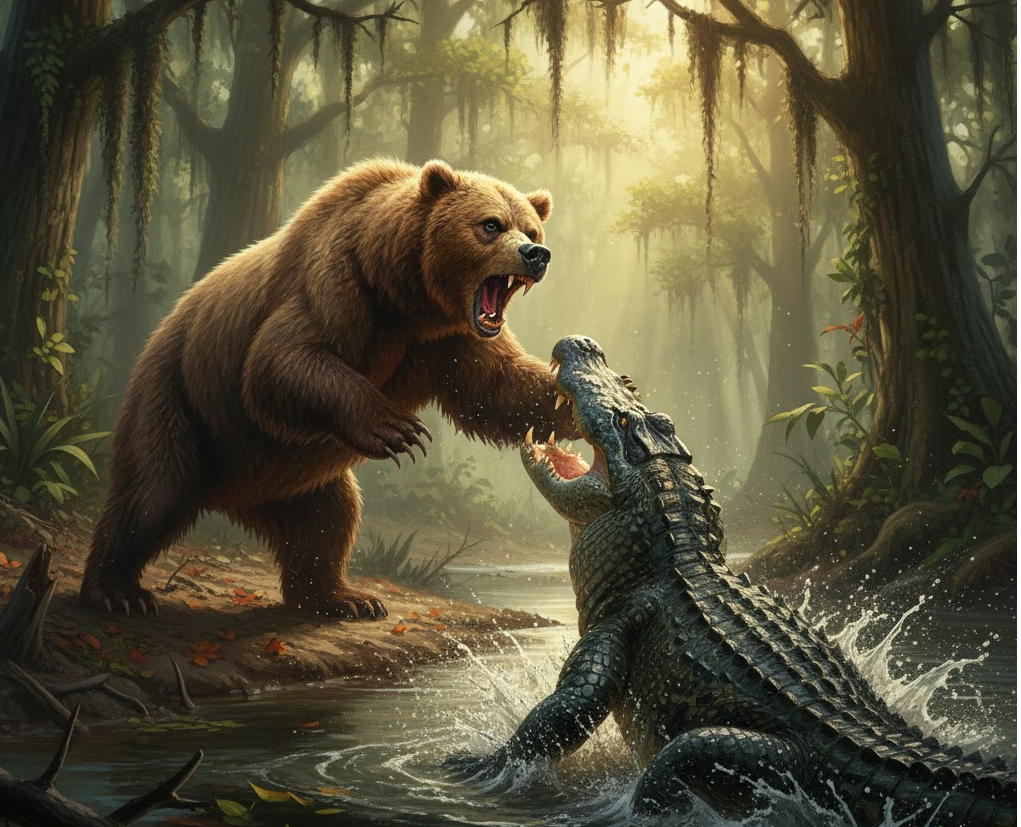
Contender 1: Grizzly Bear
The grizzly bear stands as one of North America’s most formidable land predators. Adult males typically weigh between 400 and 790 pounds, though some individuals reach over 1,000 pounds. They stand roughly 3.5 feet tall at the shoulder on all fours, but rear up to 8 feet when standing on hind legs.
These bears possess incredible physical strength that exceeds most other animals. Their massive forelimbs contain powerful muscles capable of flipping over 700-pound rocks with ease. Each paw carries five curved claws measuring 2 to 4 inches long, perfect for digging, climbing, and combat. The bear’s thick hide and dense fur provide significant protection against attacks.
Grizzlies pack serious offensive weapons beyond their claws. Their jaws deliver a bite force between 975 and 1,200 PSI, strong enough to crush bowling balls. The bear’s canine teeth measure up to 2.5 inches, designed to grip and tear flesh. Their jaw muscles allow them to bite through bone without difficulty.
Speed and agility give grizzlies surprising advantages for their size. These bears reach speeds up to 35 miles per hour in short bursts, faster than most humans can sprint. They demonstrate remarkable dexterity with their paws, capable of catching fish mid-leap and manipulating small objects. Their shoulder hump consists of pure muscle mass that powers their devastating swipes.
Fun fact: Grizzly bears possess a bite force strong enough to crush a cast iron skillet, and their sense of smell is 2,100 times better than a human’s, allowing them to detect food from 20 miles away.
Contender 2: Alligator
The American alligator represents one of Earth’s most ancient predator designs, virtually unchanged for millions of years. Adult males average 11 to 15 feet in length and weigh between 500 and 1,000 pounds. The largest recorded specimens exceeded 19 feet and weighed over 2,000 pounds. Their massive bodies sit low to the ground, built for explosive attacks from water.
An alligator’s most fearsome weapon sits in its massive jaws. These reptiles deliver the strongest bite force of any living animal, measured at 2,125 PSI in laboratory tests. That crushing power exceeds a great white shark’s bite. Their 80 conical teeth don’t chew but instead grip and tear prey apart through death rolls. Once those jaws clamp down, escape becomes nearly impossible.
The alligator’s entire body functions as armor plating. Its back features thick osteoderms, which are bony plates embedded beneath tough scales. This natural armor can deflect bullets and knife attacks. Even the belly, while softer, has overlapping scales that provide substantial protection. Their tail serves as both a weapon and a rudder, capable of delivering bone-breaking strikes.
These predators evolved for ambush hunting in aquatic environments. Alligators use explosive bursts of speed to launch attacks, moving up to 20 miles per hour on land for short distances. In water, they’re even more dangerous, swimming at speeds up to 20 miles per hour with perfect stealth. Their eyes, ears, and nostrils sit on top of their heads, allowing them to remain almost completely submerged while watching prey.
Alligators possess remarkable endurance despite their cold-blooded nature. They can hold their breath underwater for up to two hours when remaining still. Their immune system fights off infections that would kill most animals, allowing them to heal from severe wounds. The death roll technique they employ spins at incredible speeds, disorienting prey and tearing off chunks of flesh.
Fun fact: An alligator’s jaw muscles for biting down are incredibly powerful, but the muscles for opening their jaws are so weak that a human can hold an alligator’s mouth shut with bare hands.
Head-to-Head
| Attribute | Grizzly Bear | Alligator |
|---|---|---|
| Size | 3.5 ft tall (shoulder), 8 ft standing | 11-15 ft long |
| Weight | 400-790 lbs (up to 1,000 lbs) | 500-1,000 lbs |
| Speed | 35 mph | 20 mph (land), 20 mph (water) |
| Bite Force | 975-1,200 PSI | 2,125 PSI |
| Key Strength | Versatility and intelligence | Strongest bite force on Earth |
| Main Weakness | Vulnerable underbelly | Weak jaw-opening muscles |
| Offense Tools | 2-4 inch claws, powerful jaws, brute strength | Crushing jaws, 80 teeth, death roll |
| Defense Tools | Thick hide, dense fur, massive size | Armored scales, osteoderms, low profile |
| Combat Strategy | Aggressive, multi-directional attacks | Ambush and clamp down |
Grizzly Bear vs. Alligator: The Showdown
The encounter begins on a riverbank where both predators meet by chance. The grizzly approaches the water’s edge to fish during salmon season. The alligator basks in shallow water near the shore, seeking warmth from the afternoon sun. Neither animal expects to confront such a dangerous opponent.
The bear spots the alligator first. It evaluates the threat, standing on hind legs to appear larger and more intimidating. The grizzly drops back down and circles cautiously, keeping distance while assessing this strange creature. The alligator tracks the bear’s movement with cold eyes, remaining motionless except for subtle shifts in position.
Tension breaks when the bear moves closer to investigate. The alligator explodes from the water with shocking speed, jaws wide open. The bear reacts with equal quickness, swiping sideways with its massive paw. The blow connects with the alligator’s head, sending the reptile sliding across the muddy bank. Those claws rake across armored scales but fail to penetrate deeply.
The alligator recovers and lunges again, this time aiming for the bear’s leg. Those massive jaws clamp down with bone-crushing force, sinking teeth into muscle and tissue. The bear roars in pain and fury. It immediately retaliates with a devastating strike to the alligator’s back, using its full weight and strength. The force of the blow staggers even the armored reptile.
Pain drives the grizzly into a frenzy. It attacks with both paws, raining blows on the alligator’s body. Each strike carries hundreds of pounds of force behind it. The alligator’s armor protects its back and sides, but the repeated impacts take their toll. The reptile attempts its signature death roll, spinning violently while maintaining its grip on the bear’s leg.
The death roll proves partially effective. The bear stumbles and nearly falls, but its superior size and strength keep it upright. The grizzly uses this moment to its advantage, bringing both paws down on the alligator’s head and snout. These targeted strikes hit the reptile’s most vulnerable areas. The alligator’s grip weakens as its brain rattles from the concussive blows.
Sensing an opening, the bear shifts strategy. It positions itself behind the alligator, away from those lethal jaws. The grizzly’s claws find purchase on the alligator’s softer underbelly as it flips the reptile over. The exposed belly presents a clear target. The bear bites down on the alligator’s throat area, its powerful jaws crunching through scales and tissue.
The alligator thrashes wildly, tail whipping back and forth. One powerful tail strike connects with the bear’s ribs, cracking bones with an audible snap. The bear grunts but doesn’t release its hold. Its survival instincts push through the pain. The grizzly continues to maul the alligator’s vulnerable underside, claws tearing and jaws crushing.
The fight reaches its conclusion after several brutal minutes. The alligator’s movements slow considerably as blood loss and internal injuries mount. The bear’s superior versatility and ability to attack from multiple angles proves decisive. The alligator’s best weapon, its bite, landed successfully but couldn’t overcome the bear’s relentless assault. The grizzly bear emerges victorious with roughly 70% probability in this matchup, though severely injured from the alligator’s bite and tail strikes.
Grizzly Bear vs. Alligator: Who Would Win?
The grizzly bear wins this fight in most scenarios due to its versatility, intelligence, and ability to attack from multiple angles. While the alligator possesses the stronger bite force and better armor, it lacks the mobility and tactical options needed to overcome a full-grown grizzly on land.
Points to note:
- The fight location drastically changes the outcome; an alligator in deep water gains significant advantages and could win by drowning the bear
- A grizzly’s intelligence allows it to learn and adapt during combat, targeting weak spots like the alligator’s eyes, throat, and belly
- An alligator’s stamina on land decreases rapidly, especially in warm weather, as they are cold-blooded creatures
- The bear’s injuries from an alligator bite would likely prove serious or fatal even if it wins the immediate fight due to infection risks
- Size differences between individual animals matter greatly; a 1,000-pound grizzly versus a 500-pound alligator changes the dynamic considerably
- These animals occupy completely different habitats and would almost never encounter each other naturally in the wild
- The alligator’s armored back protects it from most of the bear’s attacks, but its softer underbelly remains vulnerable
- A grizzly’s endurance and ability to fight for extended periods gives it an edge in prolonged combat