
Two of Australia’s most formidable native animals possess weapons that could prove deadly in combat. The cassowary wields dagger-like claws and a powerful kick, while the kangaroo brings boxing skills and a devastating rear leg strike to any confrontation.
This analysis examines the physical capabilities, fighting strategies, and likely outcome when these two remarkable creatures clash. Readers will discover which animal holds the advantage and why their unique adaptations tip the scales in battle.
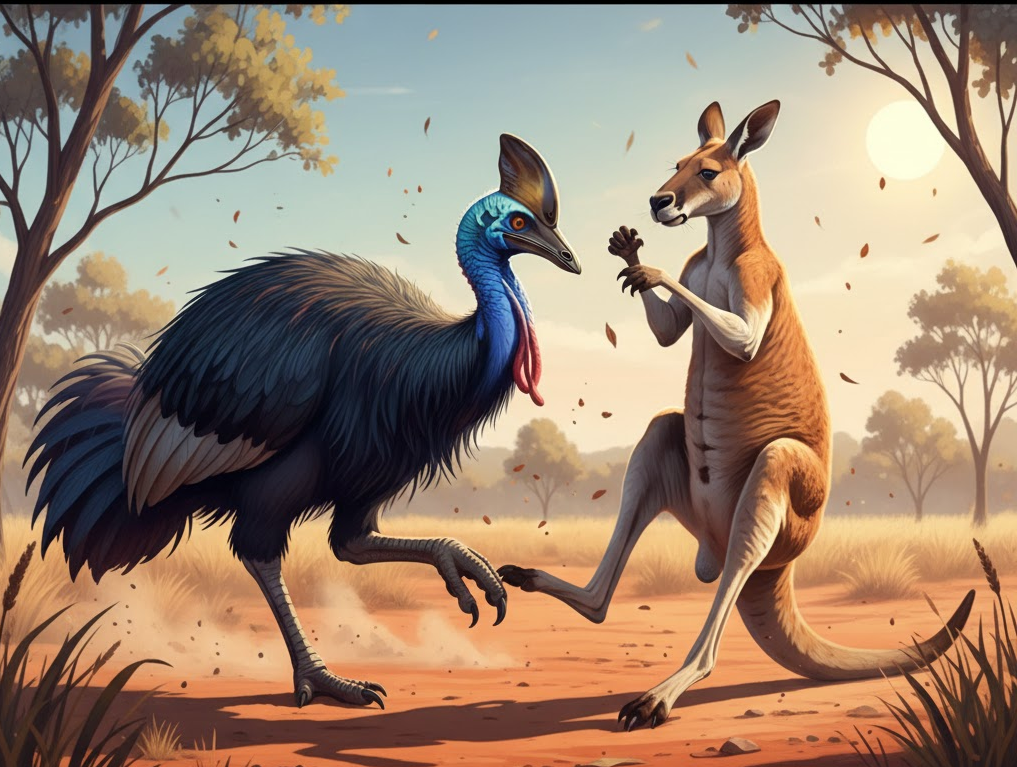
Contender 1: Cassowary
The cassowary stands as one of the most dangerous birds on Earth, reaching heights of up to 6 feet and carrying a prehistoric presence. These flightless giants possess thick, powerful legs built like tree trunks that can generate incredible force. Their bodies are covered in coarse, hair-like feathers that offer some protection against strikes.
The cassowary’s most fearsome weapon sits on each foot: a single dagger-shaped claw measuring up to 5 inches long. This razor-sharp talon can slice through flesh, bone, and organs with terrifying efficiency. The bird can leap nearly 5 feet into the air and deliver slashing kicks that have killed humans and dogs.
Beyond the killer claws, cassowaries pack a bone casque atop their heads made of solid keratin. This helmet-like structure can be used as a battering ram when the bird charges at enemies. The casque also provides protection for the skull during aggressive encounters.
Their neck muscles are remarkably strong, allowing them to peck with enough force to cause serious injury. Cassowaries can run at speeds reaching 31 mph through dense rainforest, using their powerful legs to leap over obstacles. The birds typically weigh between 75 to 130 pounds, with females being larger and more aggressive than males.
Fun fact: Cassowaries have been known to disembowel full-grown dogs and pigs with a single kick, and they remain one of the only birds to have killed adult humans in documented attacks.
Contender 2: Kangaroo
The red kangaroo claims the title of largest marsupial on the planet, with males standing over 6 feet tall when upright. These muscular animals can weigh up to 200 pounds, with powerful hindquarters that make up most of their mass. Their thick tail acts as a third leg, providing balance and support during fights.
Kangaroos possess incredibly strong hind legs capable of delivering kicks with over 850 pounds of force. These legs can crush bones, rupture organs, and send opponents flying through the air. Male kangaroos engage in boxing matches for dominance, developing refined fighting skills through constant practice.
Their forelimbs, while shorter than their legs, feature sharp claws that can grab and rake opponents. Kangaroos use these arms to clinch enemies close while positioning for a devastating kick. The animal’s thick hide provides decent protection against slashing attacks and scratches.
A kangaroo’s hop allows it to cover 25 feet in a single bound and reach speeds of 35 mph when fleeing danger. This mobility gives them options to retreat, reposition, or launch surprise attacks during combat. Their eyesight is excellent, helping them track moving threats from considerable distances.
The animal’s fighting style combines boxing techniques with powerful kicks delivered while balanced on the tail. Kangaroos can lean back on their tails and strike with both hind legs simultaneously, doubling their offensive power. This tactic proves especially effective against predators like dingoes.
Fun fact: Male kangaroos have been observed drowning attacking dogs by holding them underwater, showing these animals possess both intelligence and ruthlessness when their lives are threatened.
Head-to-Head
| Category | Cassowary | Kangaroo |
|---|---|---|
| Size | Up to 6 feet tall | Up to 6 feet tall |
| Weight | 75-130 pounds | 120-200 pounds |
| Speed | 31 mph | 35 mph |
| Bite Force | Weak (pecking only) | Minimal (not primary weapon) |
| Key Strength | 5-inch dagger claws | Powerful hind legs (850+ lbs force) |
| Main Weakness | Lighter build, less reach | Vulnerable belly, slower reactions |
| Offense Tools | Slashing kicks, head strikes, pecks | Boxing jabs, crushing kicks, claw rakes |
| Defense Tools | Speed, casque helmet, thick feathers | Thick hide, mobility, tail balance |
| Combat Strategy | Aggressive charges, leap and slash | Box and position, tail-balanced kicks |
Cassowary vs. Kangaroo: The Showdown
The confrontation begins when a large male red kangaroo ventures too close to a cassowary’s territory near a rainforest creek. The bird immediately recognizes the threat and puffs up its feathers, releasing a deep booming call. The kangaroo, equally territorial, refuses to back down and rises to full height.
The cassowary makes the first move, charging forward with surprising speed. Its head lowered, the bird covers the 20-foot distance in seconds. The kangaroo attempts a boxing jab but the cassowary ducks under it, slamming its casque into the marsupial’s chest. The impact staggers the kangaroo backward.
Recovering quickly, the kangaroo grabs the cassowary’s neck with both forelimbs. The bird thrashes violently, its powerful neck muscles preventing the kangaroo from gaining control. Both animals struggle for position, their feet searching for solid ground to launch attacks.
The cassowary breaks free and immediately jumps, bringing one leg up in a slashing motion. The 5-inch claw catches the kangaroo’s shoulder, opening a deep gash. Blood flows from the wound. The kangaroo grunts in pain but responds by leaning back on its tail.
Balanced on its muscular tail, the kangaroo unleashes both hind legs in a devastating double kick. The blow catches the cassowary square in the chest with over 1,500 pounds of combined force. The bird flies backward, crashing into the ground six feet away. Several ribs crack from the impact.
The cassowary struggles to its feet, wheezing and clearly injured. Its lighter frame cannot absorb such powerful strikes. The kangaroo hops forward, sensing victory. The bird attempts another slashing kick but moves slower now, the broken ribs affecting its agility.
The kangaroo easily dodges the weakened attack. It closes the distance and delivers another crushing kick to the cassowary’s side. This second blow lands with full force, causing massive internal damage. The bird collapses, unable to continue fighting.
The kangaroo stands victorious, its superior weight and raw kicking power proving decisive. Though injured and bleeding from the claw wound, the marsupial survives the encounter. The cassowary’s deadly talons inflicted damage but could not overcome the kangaroo’s physical advantages. A larger male kangaroo would win this fight roughly 70% of the time against an average cassowary.
Cassowary vs. Kangaroo: Who Would Win?
The kangaroo emerges as the likely victor due to its superior size, weight, and devastating kicking force that can crush bone and rupture organs. While the cassowary’s dagger claws present a serious threat, the kangaroo’s ability to deliver over 850 pounds of force per kick from a tail-balanced position gives it a decisive advantage in close combat.
Points to note:
- A particularly large female cassowary (130+ pounds) facing a smaller male kangaroo could shift the odds, especially if the bird lands early slashing strikes to vital areas
- These animals rarely encounter each other in nature as cassowaries prefer dense rainforest while kangaroos inhabit open grasslands and woodlands
- The cassowary’s agility and speed could allow it to win if it avoids direct exchanges and fights a hit-and-run battle
- Environmental factors matter significantly, with the cassowary holding advantages in dense forest where the kangaroo cannot maneuver as effectively
- A kangaroo’s thick hide provides better protection against the cassowary’s claws than the bird’s feathers provide against crushing kicks
- Both animals typically avoid fighting to the death in nature, preferring to establish dominance and retreat rather than risk fatal injuries
- The outcome depends heavily on which animal strikes first and whether those initial attacks cause debilitating damage