
Few creatures inspire as much fear as the cassowary, a bird known for killing humans with its dagger-like claws. But what happens when this giant bird faces off against one of nature’s most loyal predators?
This fight pits raw avian power against centuries of domesticated hunting instincts. The outcome depends on size, weaponry, and fighting style.
Readers will learn about each animal’s strengths and weaknesses, how their natural weapons compare, and which creature would most likely walk away from this brutal encounter.
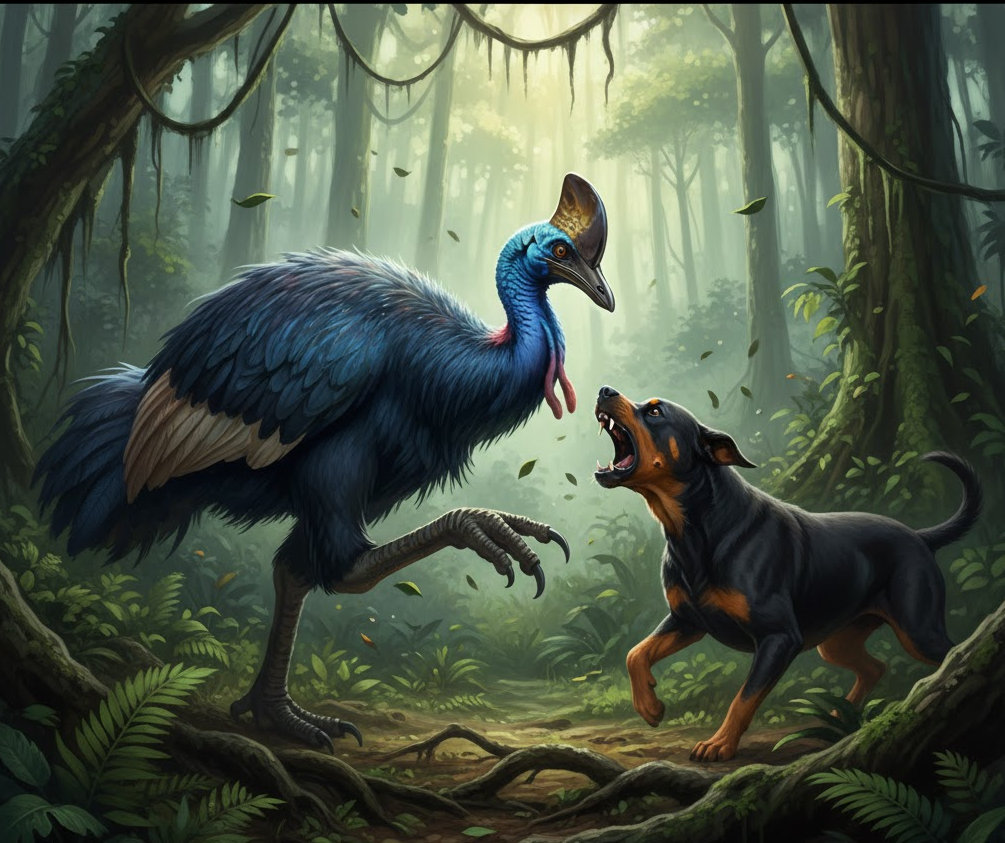
Contender 1: Cassowary
The cassowary stands as the second-heaviest bird on Earth, reaching heights of 5 to 6 feet tall. Adult birds weigh between 75 and 130 pounds, with females typically larger than males. Their powerful legs end in three-toed feet, each bearing a deadly inner claw that can grow up to 5 inches long.
This massive bird’s head features a hard casque, a helmet-like structure made of keratin. The casque protects the skull during fights and crashes through dense forest undergrowth. Cassowaries use this bony crown as a battering ram when threatened.
The bird’s most dangerous weapon remains its middle toe claw. Sharp as a blade and strong as steel, this claw can disembowel predators with a single kick. Cassowaries attack by jumping and slashing downward, delivering kicks that carry their full body weight behind each strike.
Their thick, coarse feathers provide surprising protection against bites and scratches. The neck and head lack this armor, creating a vulnerable target for attackers. Despite their bulk, cassowaries can sprint at speeds up to 31 miles per hour through dense jungle terrain.
Fun fact: Cassowaries can leap nearly 5 feet straight up from a standing position, allowing them to deliver devastating aerial kicks that can crush bones and rupture organs.
Contender 2: Dog
Dogs vary dramatically in size, from tiny Chihuahuas to massive mastiffs. For this comparison, consider a large, athletic breed weighing between 60 and 90 pounds. These animals stand 2 to 2.5 feet tall at the shoulder, built with muscle designed for running, jumping, and fighting.
The dog’s primary weapon is its bite. Large breeds can deliver bite forces ranging from 230 to 330 pounds per square inch. Their jaws lock onto targets with crushing pressure, and their sharp teeth can tear through flesh and break bones. Multiple teeth working together create wounds that bleed heavily and weaken opponents quickly.
Speed gives dogs a major advantage in combat. Most large breeds can reach speeds of 25 to 30 miles per hour, with some running even faster in short bursts. Their agility allows quick direction changes, dodging attacks, and circling around slower opponents.
Dogs possess exceptional stamina compared to many animals. They can maintain high activity levels for extended periods, wearing down opponents through relentless attacks. This endurance comes from thousands of years of breeding for hunting and fighting.
Their thick fur and loose skin provide moderate protection against slashing attacks. The neck area, protected by muscle and fur, can withstand significant punishment. However, the belly, legs, and face remain vulnerable to powerful strikes.
Domestic dogs rely on pack hunting instincts even when fighting alone. They target weak points, retreat when injured, and use tactical thinking rather than pure aggression. This intelligence makes them unpredictable and adaptable fighters.
Fun fact: A dog’s reaction time is three times faster than a human’s, allowing them to dodge and counter attacks with lightning speed that most animals cannot match.
Head-to-Head
| Category | Cassowary | Dog |
|---|---|---|
| Size | 5-6 feet tall | 2-2.5 feet tall (at shoulder) |
| Weight | 75-130 pounds | 60-90 pounds |
| Speed | 31 mph | 25-30 mph |
| Bite Force | Weak (bird beak) | 230-330 PSI |
| Key Strength | 5-inch slashing claws | Powerful bite and agility |
| Main Weakness | Vulnerable neck and head | Smaller size and reach disadvantage |
| Offense Tools | Kicking claws, casque battering | Crushing bite, multiple teeth |
| Defense Tools | Thick feathers, casque helmet | Fur, loose skin, quick dodging |
| Combat Strategy | Powerful kicks and charges | Bite and hold, target weak spots |
Cassowary vs. Dog: The Showdown
The cassowary spots the dog approaching through the forest clearing. It raises itself to full height, feathers bristling outward to appear even larger. The dog slows, circling warily, hackles raised and teeth bared.
The dog makes the first move, darting forward to test the bird’s reactions. The cassowary responds instantly with a forward kick that whistles through the air. The dog dodges left, avoiding the deadly claw by inches.
Both animals pause, reassessing. The cassowary hisses, a deep rumbling sound that vibrates through its chest. The dog continues circling, looking for an opening.
The dog rushes in again, this time from the side. It aims for the cassowary’s leg, hoping to cripple the bird’s mobility. The cassowary pivots with surprising speed and delivers a brutal downward kick. The claw catches the dog’s shoulder, tearing through fur and muscle.
Blood flows from the wound. The dog yelps but doesn’t retreat. Instead, it attacks more aggressively, knowing it needs to end this fight quickly.
The dog lunges for the cassowary’s neck, the most vulnerable target. It leaps upward, jaws open wide. The cassowary jumps simultaneously, using its powerful legs to launch into the air. The bird’s claw catches the dog mid-leap, striking its ribcage with devastating force.
The impact sends the dog crashing to the ground. It struggles to stand, ribs cracked or broken. The cassowary lands and immediately charges, lowering its casque like a battering ram.
The dog tries to roll away, but the bird’s speed overwhelms it. The cassowary’s helmet connects with the dog’s body, driving it into the dirt. Another kick follows, this one aimed at the vital organs.
The dog manages one desperate bite at the cassowary’s leg. Its teeth sink in, but the thick feathers and tough skin prevent deep penetration. The cassowary barely notices, delivering another crushing kick to the dog’s spine.
Within seconds, the fight ends. The dog lies motionless, overwhelmed by the cassowary’s superior reach, power, and weaponry. The bird won decisively, likely with an 85-90% chance of victory in most encounters.
Cassowary vs. Dog: Who Would Win?
The cassowary would almost certainly win this fight due to its devastating kicking power and superior size. A single well-placed strike from its 5-inch claw can cause fatal injuries that even the toughest dog cannot survive.
Points to note:
- Breed matters significantly – A massive mastiff or Kangal weighing 150-200 pounds would have better odds than an average large dog, possibly shifting the outcome to 60-70% in the cassowary’s favor.
- Multiple dogs change everything – Two or more dogs working together could overwhelm a cassowary by attacking from different angles, preventing the bird from defending all sides effectively.
- Environment affects the outcome – In tight spaces where the cassowary cannot kick effectively, a dog’s agility advantage increases. Open areas favor the bird’s powerful strikes.
- These animals rarely meet in nature – Cassowaries live in tropical rainforests of Australia and New Guinea, while most dogs live with humans far from these habitats.
- First strike importance – If the dog manages to grab the cassowary’s neck before taking any kicks, it could potentially win by crushing the windpipe or severing major blood vessels.
- Experience level varies – A cassowary defending territory or chicks fights more aggressively than usual, while a trained guard or fighting dog brings tactical advantages most pets lack.
- Injury tolerance differs – Cassowaries fight until severely wounded, showing little fear response. Some dogs retreat after minor injuries, while others fight through extreme pain.